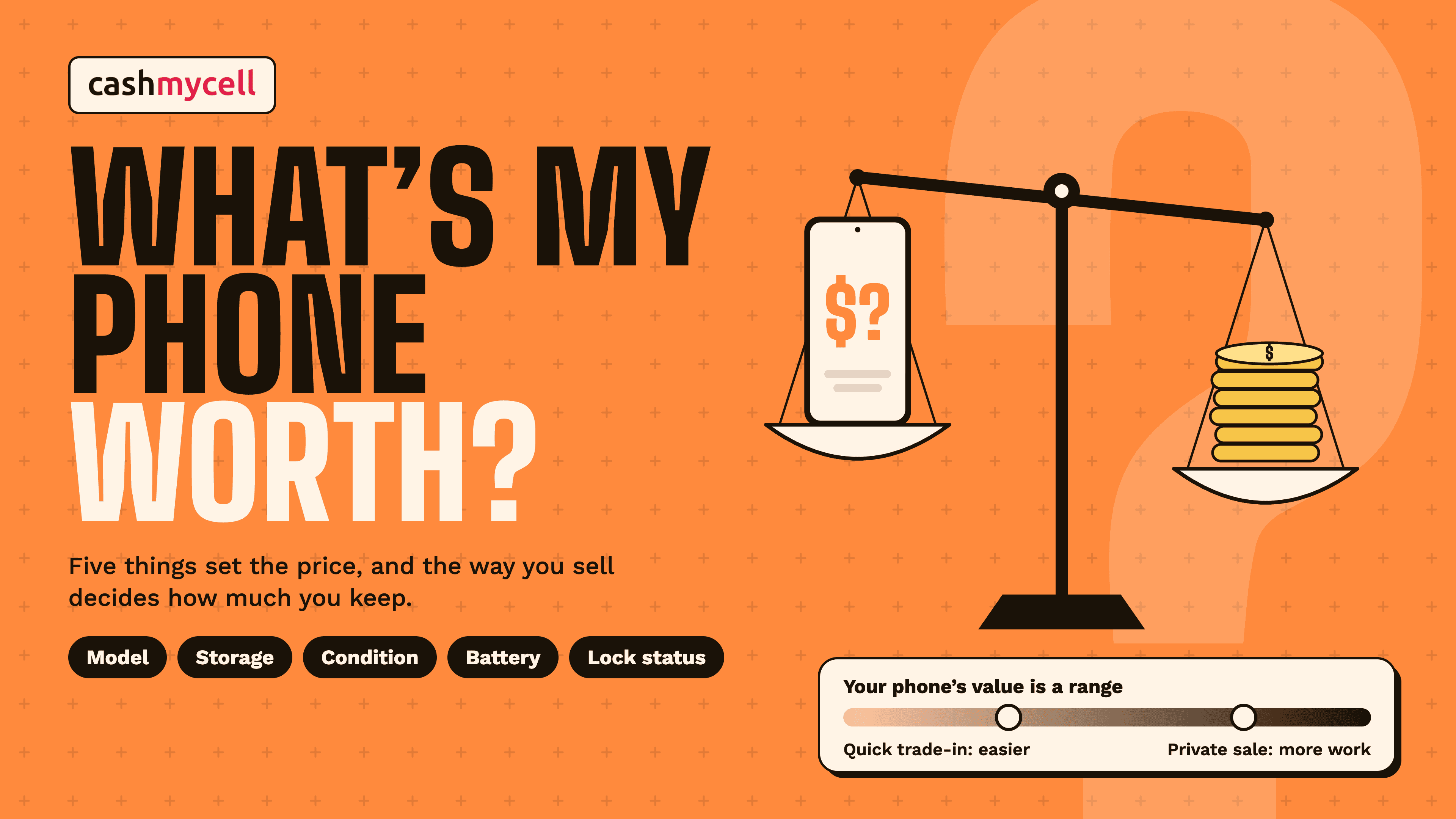
If you have an old smartphone in a drawer, it may be worth more than you think. Your phone’s value depends on the model, condition, storage size, carrier status, demand, and whether you choose a quick trade-in or sell it yourself. This guide explains how to estimate your phone’s value, protect your data, and choose the right path for getting the best practical return.
What's my phone worth?
Your phone is worth what a buyer, retailer, carrier, or resale platform is willing to pay for that exact device in its current condition. To estimate it, identify the model and storage size, check whether it is unlocked, inspect the physical and battery condition, then compare offers from trade-in programs and resale marketplaces. The number you see can vary because trade-in value is usually lower but easier, while a private sale may produce a higher smartphone resale price with more effort and risk.
The quickest way to start is to gather the facts about your device before looking at offers. A phone described as “good condition” by one person might be considered “fair” by a trade-in service if it has screen burn-in, weak battery health, damaged cameras, or non-original parts. Small details matter because the buyer is pricing not just the phone itself, but the likelihood that it can be resold, refurbished, recycled, or used as credit toward another purchase.
If you have searched “what's my phone worth?” or even typed “what s my phone worth” in a hurry, the real answer is: it depends on both the device and the selling method. Two identical phones can bring different results if one is unlocked, has more storage, includes original accessories, or is listed at the right time. That is why a good estimate starts with a simple checklist, not a guess.
The main factors that shape phone value
A phone’s value is built from several pieces. Some are obvious, like cracks or age. Others are easy to overlook, such as storage capacity, carrier lock status, and whether the device can still receive software updates. Understanding these factors helps you avoid underpricing a strong device or being surprised by a lower offer.
Model and generation
Newer flagship phones usually hold more value than older or entry-level models, but brand reputation and demand also matter. A popular model with a large user base may remain easier to sell because accessories, replacement parts, and buyer interest are more common. Special editions can sometimes attract attention, but rarity does not always mean higher value if demand is low.
Generation matters because buyers compare your phone with current alternatives. If a newer model offers a major camera, battery, performance, or design upgrade, older models may lose value more quickly. If the newer model is only a modest update, the previous generation may remain attractive to budget-conscious buyers.
Storage capacity
Storage size can affect resale value because buyers often prefer phones that can hold more photos, videos, apps, and offline files. A higher-storage version of the same model typically sells for more than the base version, although the increase is not always equal to the original upgrade cost. The difference is usually most noticeable on newer, premium, or high-demand phones.
When comparing offers, make sure you are looking at the exact storage size. Confusing a 128 GB phone with a 256 GB version can lead to an inaccurate estimate. If you are selling privately, include the storage capacity clearly in the title and description so buyers do not have to ask.
Physical condition
Condition is one of the biggest value drivers. A phone with a clean screen, intact frame, working cameras, and no water damage is much easier to resell than one with cracks, dents, deep scratches, or unreliable buttons. Even cosmetic wear can move a phone from “excellent” to “good” or “fair,” which may reduce offers.
Be honest when judging condition. A tiny mark on the frame is not the same as a shattered back glass, and normal wear is not the same as structural damage. Accurate descriptions protect you from disputes and help you choose the right selling channel.
Battery health and performance
Battery condition matters because a weak battery makes a phone less convenient to use. Some buyers may accept lower battery health if the price reflects it, while others will avoid the device because replacing a battery adds time and cost. If your phone shows battery health in settings, check it before requesting quotes or listing the device.
Performance also matters. A phone that freezes, restarts, overheats, or has unreliable charging may be valued as damaged even if it looks good. Before selling, test the screen, speakers, microphone, cameras, charging port, wireless charging if available, Wi-Fi, Bluetooth, and face or fingerprint unlock.
Carrier lock and payment status
An unlocked phone usually appeals to more buyers because it can be used with more carriers. A carrier-locked phone may still have value, but the buyer pool is smaller. If your phone is eligible to be unlocked, unlocking it before selling may help you attract more interest.
Payment status is also important. A phone that is still financed, reported lost, blocked, or tied to an account can create serious problems for a buyer. Make sure the device is fully paid off and removed from your account before selling or trading it in.
Trade-in value and resale price are not the same thing
A trade-in offer is the amount a carrier, retailer, manufacturer, or buyback company will give you for your device, often as store credit, account credit, gift card, or cash. A resale price is what an individual buyer may pay on a marketplace. Trade-ins are usually more convenient, while private resale may deliver a better return if you are willing to handle photos, messages, negotiations, shipping, and potential disputes.
Think of trade-in value as the “easy button.” You answer a few questions, send in the device or bring it to a store, and receive a quoted amount if the inspection matches your description. The trade-off is that the company needs room to inspect, refurbish, resell, or recycle the phone, so the offer may be lower than what a direct buyer would pay.
Private resale can be more profitable, but it requires more work. You need to create a clear listing, respond to buyers, choose safe payment methods, package the phone carefully, and handle questions after delivery. If you are selling locally, you also need to think about where to meet and how to avoid scams.
Neither option is always best. The right choice depends on how quickly you need the money, how comfortable you are with selling online, how valuable the phone is, and whether you prefer cash, credit, or convenience.
A practical checklist before you price your phone
Before you compare quotes, take ten minutes to collect the details that buyers and trade-in tools usually ask for. This keeps your estimate accurate and helps you avoid back-and-forth later.
Use this checklist:
- Confirm the exact model: Look in your phone settings, not just on the box or receipt.
- Check the storage size: Note whether it is 64 GB, 128 GB, 256 GB, 512 GB, or another capacity.
- Identify the carrier status: Confirm whether the phone is unlocked or tied to a carrier.
- Inspect the screen: Look for cracks, scratches, dead spots, discoloration, or touch issues.
- Inspect the body: Check the frame, back glass, camera lenses, buttons, and charging port.
- Test core functions: Make sure calls, speakers, cameras, Wi-Fi, Bluetooth, charging, and biometrics work.
- Check battery health: If available, record the battery health or note battery concerns.
- Verify account removal: Make sure activation locks, cloud accounts, and screen locks can be removed.
- Gather accessories: Original box, charger, cable, or case may help presentation, even if they do not dramatically change value.
- Clean the device: A clean phone photographs better and makes a stronger first impression.
This checklist is useful whether you plan to trade in, sell locally, or list the phone online. The goal is not to make the phone seem perfect; it is to describe it accurately so the offer or listing price reflects reality.
How to estimate your smartphone resale price
The best estimate comes from comparing multiple sources, not relying on one quote. Start by checking trade-in tools from major buyers, then look at active and recently completed marketplace listings for the same model, storage size, condition, and carrier status. A realistic smartphone resale price usually sits somewhere between the lowest quick-sale offer and the highest optimistic listing.
When reviewing marketplace prices, pay attention to what actually sells, not just what people ask. A seller can list a phone at any price, but that does not mean buyers are paying it. Look for similar phones with completed sales, strong photos, and descriptions that match your device’s condition.
It also helps to compare by selling speed. If you want to sell today, you may need to price below similar listings. If you can wait, you may be able to start slightly higher and adjust if there is little interest. Pricing is a balance between speed, certainty, and return.
Here is a simple pricing approach:
- Find three quick trade-in quotes. Use them as your convenience baseline.
- Review comparable resale listings. Match model, storage, condition, and lock status.
- Ignore unrealistic outliers. Very high listings may sit unsold; very low listings may be damaged or missing details.
- Set a target price. Choose a number that reflects your preferred speed and effort.
- Decide your minimum. Know the lowest amount you will accept before negotiating.
If your phone has damage, be extra conservative. Repair costs, buyer hesitation, and inspection adjustments can all reduce the final amount. In some cases, selling a damaged phone as-is may be simpler than paying for a repair before selling.
Selling options and when each one makes sense
Different selling methods fit different priorities. A person upgrading immediately may value speed and simplicity. Someone with a newer phone in excellent condition may want to spend more time finding the strongest offer.
Carrier or manufacturer trade-in
Carrier and manufacturer trade-ins are convenient when you are upgrading through the same ecosystem. You may receive account credit, bill credit, or purchase credit toward a new device. This route can be especially appealing if the process is integrated into checkout or available in-store.
The limitation is flexibility. Credits may be tied to a purchase, account, promotion, or specific terms. Read the details carefully so you understand how and when the value is delivered.
Retailer or buyback service
Retailers and buyback companies can offer a straightforward way to turn a phone into cash, store credit, or gift card value. The process is usually structured, with condition questions and shipping or drop-off instructions. This can be a good middle ground between a carrier trade-in and a private sale.
The final value may depend on inspection. If the phone arrives with damage or missing details that were not disclosed, the offer may change. Take photos before shipping and keep tracking information until the transaction is complete.
Online marketplace sale
Online marketplaces can help you reach more buyers and potentially earn a higher price. Strong listings include clear photos, exact specifications, honest condition notes, and a direct statement about whether the phone is unlocked. Buyers appreciate transparency because it reduces uncertainty.
The downside is that you manage the process. You may deal with low offers, shipping questions, payment concerns, and return requests. Use the platform’s recommended payment and shipping tools, and avoid moving the transaction outside the marketplace if it reduces your protection.
Local sale
A local sale can be quick and avoids shipping, but safety and payment verification matter. Meet in a public place, preferably during daylight, and consider a location designed for safe exchanges if available in your area. Let the buyer inspect the phone, but keep control of the device until payment is complete.
Cash can be simple, but verify it carefully. Digital payments may be convenient, but understand whether they can be reversed or disputed. If anything feels rushed, confusing, or suspicious, it is reasonable to walk away.
Small steps that can improve buyer confidence
You do not need to over-polish the phone or make exaggerated claims. Instead, focus on reducing buyer uncertainty. A buyer who trusts your listing or trade-in description is more likely to move forward.
Before listing or shipping, do the following:
- Clean the screen, camera lenses, and ports gently.
- Photograph the phone in good lighting from multiple angles.
- Show any scratches, dents, or cracks clearly.
- Include a screenshot or note showing storage size and model, without exposing personal information.
- State whether the phone is unlocked, carrier-locked, or unknown.
- Mention battery health if your phone displays it.
- Remove your account, erase the phone, and confirm it reaches the setup screen.
- Package it securely if shipping, with padding around the device.
These steps do not guarantee a higher price, but they can make your phone easier to evaluate. Confidence matters because used-phone buyers are trying to avoid hidden problems.
Data safety comes before selling
Before handing over any phone, protect your personal information. Back up anything you want to keep, including photos, contacts, messages, notes, and app data. Then sign out of accounts, remove payment cards, turn off device-finding features, unpair watches or accessories, and perform a factory reset.
Do not skip account removal. Many modern phones include activation locks that prevent another person from setting up the device if it is still connected to your account. A phone that cannot be activated may lose much of its value or be rejected by a trade-in program.
After resetting, restart the phone and confirm it shows the initial setup screen. Remove SIM cards and memory cards if your device uses them. If you are shipping the phone, keep proof of the reset, photos of the condition, and tracking details until the transaction is finished.
Common mistakes that lower your return
Many people lose value not because their phone is bad, but because they rush the process. A vague listing, poor photos, missing storage details, or an uncertain carrier status can make buyers hesitate. If buyers have to ask basic questions, they may move on to a clearer listing.
Another common mistake is overestimating condition. A phone with a cracked back, weak battery, or camera issue should not be listed as excellent. Accurate condition may attract the right buyer faster than an inflated description that leads to disputes.
Timing can also matter. Phones often attract attention around upgrade cycles, gift seasons, and after new models are announced, but demand can shift. If you know you will replace your phone soon, checking its value early can help you avoid waiting until it has lost more appeal.
Finally, do not forget the convenience factor. Holding out for the highest possible price may not be worth weeks of messages and uncertainty. Sometimes the best deal is the one that gives you a fair return with the least hassle.
The takeaway
Your phone’s worth is not a single fixed number. It is a range shaped by model, storage, condition, battery, lock status, demand, and the selling method you choose. A trade-in may be best when you want speed and simplicity, while private resale may be better if you want to work for a potentially higher return.
Start with the facts, compare multiple offers, and be honest about condition. Once you understand both the trade-in value and likely resale price, you can decide whether to trade, sell, or keep the device as a backup. The smartest move is not always chasing the highest number; it is choosing the option that fits your time, risk comfort, and upgrade plans.