
Consider a common scenario. Someone upgrades to a new phone after noticing a growing crack across the old screen and decides to put the device aside "for now." A few months pass. Then a year. And the old phone ends up in one of two places: forgotten in a drawer or buried inside that random box of old chargers, tangled earphones, mystery cables, and accessories nobody remembers buying in the first place.
By that point, many people assume the device has no value left. The screen is shattered, the battery struggles to last half a day, or the charging port only works when the cable sits at a very specific angle.
Surprisingly, that doesn't always mean the phone is worthless. Buyers often evaluate damaged phones differently than owners do. The key question isn't whether your phone is broken. It's whether someone else can still make use of it.
Is Your Broken Phone Actually Worth Anything?
Most people ask:
"Can I still use this phone today?"
A buyer is more likely to ask:
"Can this phone be repaired, refurbished, or used for parts?"
That difference in perspective is important. Many damaged phones still have a market because repair shops, refurbishers, and parts buyers see something owners often overlook: usable components, repair opportunities, and resale potential. Whether your phone has a cracked display, water damage from an unfortunate accident, a battery that dies quickly, a camera that no longer focuses, or a device that refuses to turn on completely, there is still a reasonable chance someone may be interested in buying it.
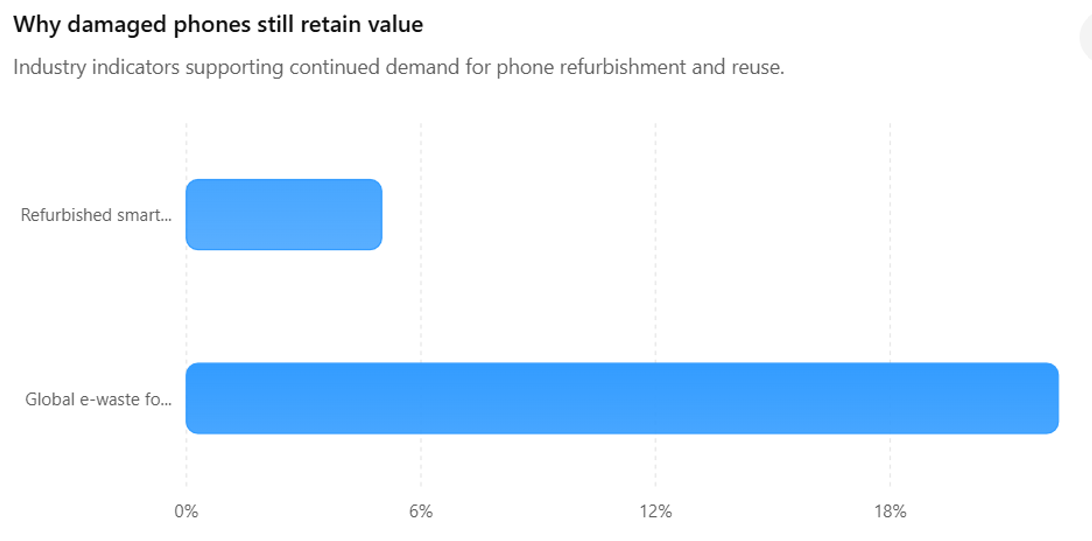
Industry trends support this demand. According to Counterpoint Research, global refurbished smartphone sales grew 5% in 2024 and have shown steady growth in recent years. The refurbished market has remained resilient even as the broader smartphone industry has experienced periods of slower growth. Devices with repairable damage can be refurbished, while others still have value as sources of replacement parts. The electronics industry is also placing greater emphasis on extending device lifecycles due to growing global e-waste considerations.
Where Can You Sell Your Phone?
The next step is deciding which selling option makes the most sense for your situation. There are six common ways to sell a damaged phone:
Carrier or manufacturer trade-in programs
Local repair shops
Online marketplaces
Pawn shops
Electronics recycling programs
Each option suits a different type of seller.
Your Main Selling Options at a Glance
| Selling Option | Best For | Main Advantage | Main Drawback |
| Online Buyback Companies | Convenience | Fast quotes, prepaid shipping, and simple transactions | The final offer may change after inspection |
| Trade-In Programs | Upgrading to a new device | Easy process that fits into a new purchase | Many programs offer store credit instead of cash |
| Local Repair Shops | Immediate local sales | No packaging or shipping required | Prices can vary widely between shops |
| Online Marketplaces | Getting the highest possible price | You control the listing and price | Requires patience, communication, and more effort |
| Pawn Shops | Same-day cash | Fast payment with minimal effort | Usually provides lower offers |
| Recycling Programs | Phones with little or no resale value | Environmentally responsible disposal | Usually no financial return |
The challenge lies in deciding what matters most to you. Some people want the highest possible payout, while others would rather complete the process quickly and never think about that phone again.
The highest price, the fastest payment, and the least amount of effort rarely come together in a single option. In most cases, you'll need to decide which factor matters most.
What Makes One Broken Phone Worth More Than Another?
Not all damaged phones are treated equally. A relatively recent flagship phone with a cracked display can still receive a surprisingly good offer. At the same time, an older budget phone with multiple issues may have very little resale value regardless of its cosmetic condition.
Before making an offer, buyers typically consider:
- Brand and model.
- Storage capacity.
- Device age.
- Current market demand.
- Type and severity of damange.
- Whether the phone powers on.
- Carrier lock status.
- IMEI status.
- Activation lock status
Consider a seller with a two-year-old flagship phone and a cracked display. One buyer may evaluate it primarily as a source of replacement parts, while another may see it as an easy refurbishment project. Because buyers use different business models, offers for the exact same device can vary significantly. This is why comparing multiple quotes is usually worth the effort.
A phone that powers on and functions normally aside from a cracked screen is often easier to value than a device that refuses to turn on. Repair costs for screen damage are relatively predictable.
Why Some Broken Phones Are Harder to Sell
Some problems are minor inconveniences. Others create serious barriers to resale. Your phone may be harder to sell if it:
- Has been reported lost or stolen
- Has a blacklisted IMEI
- Is protected by an activation lock
- Has an unpaid financing agreement
- Has severe water or fire damage
- Is missing important internal components
- Is an older model with limited demand
Industry buyers often point out that physical damage is not always the biggest obstacle. A cracked screen can usually be replaced. A battery can often be replaced. A charging port can frequently be repaired.
Software and ownership restrictions are critical barriers. Activation locks, blacklisted IMEI numbers, and unpaid financing agreements can significantly reduce a phone's value because they limit what a future buyer can legally do with the device.
So, Where Can You Actually Get the Most Money?
If your goal is maximizing profit, online marketplaces usually have the advantage. Online marketplaces often produce the highest payouts because you're selling directly to another person rather than to a company that needs to leave room for profit. Platforms such as Facebook Marketplace, eBay, and OLX are popular choices because they attract buyers looking for repair projects, discounted devices, or replacement parts.
The trade-off is that selling directly requires more effort. You'll need to create a listing, answer questions, negotiate prices, and occasionally deal with buyers who stop responding after expressing interest. Many sellers find the extra work worthwhile for newer devices with strong resale value. For older phones, the convenience of a buyback company or local repair shop may be more appealing.
Platforms such as Facebook Marketplace, eBay, and OLX allow sellers to set their own prices and negotiate directly with buyers. This often results in higher payouts than trade-in programs, repair shops, or pawn shops.
However, higher payouts come at the cost of time and effort. You'll need to manage listings, communicate with buyers, answer questions, and sometimes deal with negotiations that go nowhere.
For higher-value phones, many sellers find that the additional effort is justified. For older devices worth relatively little, convenience often becomes the deciding factor.
Trade-In Programs: Worth Considering?
If you're already planning to upgrade, trade-in programs can be one of the easiest options available.
Programs offered by Apple, Samsung, and major mobile carriers allow customers to apply the value of an old device toward a new purchase. While trade-ins don't always produce the highest payout, they can save time and eliminate the need to find a separate buyer.
A common mistake sellers make is focusing only on the advertised trade-in value while overlooking promotional incentives. In some cases, bonus credits offered during promotions can make a trade-in surprisingly competitive compared to selling privately.
If convenience matters more than maximizing every dollar, trade-in programs are worth checking before exploring other options.
What About Local Repair Shops?
Local repair shops are often overlooked, but they can be a practical option.
Many repair businesses purchase damaged phones for refurbishment or parts. The process is usually straightforward: bring the device in, receive an offer, and decide whether to accept it.
The biggest advantage is speed. There's no shipping, no waiting for inspections, and no need to manage online listings.
The downside is that offers can vary dramatically between shops. One repair business may specialize in refurbishing newer devices, while another may primarily purchase phones for parts. Getting quotes from multiple locations can sometimes make a meaningful difference.
A Common Misconception About Phone Resale Value
Interestingly, many sellers tend to underestimate the value of newer phones with visible damage while overestimating the value of much older devices.
A three-year-old flagship phone with a cracked screen may attract far more buyer interest than a seven-year-old budget phone in excellent cosmetic condition. In the resale market, age, demand, and repair potential often matter more than appearance alone.
That's one reason assumptions can be expensive. A quick quote request or marketplace search can reveal a very different value than expected.
Final Thoughts
The biggest mistake people make is assuming a broken phone has no value at all.
Sometimes an old device really is too outdated or too damaged to be worth much. But many phones still have value as repair projects, refurbishment candidates, or sources of replacement parts.
Before throwing your phone away or letting it sit in a drawer for another few years, spend a few minutes exploring your options. Get quotes from a couple of buyback companies, check local repair shops, review trade-in offers, and look at recent marketplace listings for similar devices.
You probably won't discover a hidden treasure. But you may discover that a phone you considered worthless is still worth more than you expected.
Before You Sell Your Phone
- Back up any important photos, contacts, and files.
- Remove personal accounts and activation locks where possible.
- Factory reset the device if it still powers on.
- Remove SIM and memory cards.
- Check offers from multiple buyers.
- Document the phone's condition with photos.
These steps can help protect your personal information while also making it easier for buyers to evaluate the device accurately.