
When the AI assistant on your smartphone recommends a healthier bedtime or alerts you to an irregular heart rhythm, it's leveraging insights drawn from millions of real-world health data points. By identifying patterns at a scale no individual could, AI can recognize subtle signals long before they become obvious.
This moved into the spotlight this month when the Samsung Health app introduced a new consent setting allowing users to decide whether their health information could be used for AI training triggering immediate backlash.
The controversy is a preview of a much larger question around smartphone health apps: How much personal health data are consumers willing to exchange for smarter digital healthcare?
A confusing consent prompt exposed a growing trust problem
The original Samsung Health prompt appeared straightforward.
It asked for consent to let Samsung use health information, including sleep data, activity, medications, medical records, and menstrual cycle information, for AI training and modelling. When Samsung users declined, they were warned that syncing could stop and health data could be deleted.
Within hours, screenshots spread across technology forums and news sites. Samsung later clarified that the warning referred only to AI-training datasets stored separately from users' primary Samsung Health records. Health tracking and synchronization would continue functioning normally after opting out, and the company confirmed it would revise the language to avoid confusion.
Ironically, the clarification solved the technical misunderstanding, but not the trust issue. If smartphone users cannot immediately understand what happens to their health information, confidence erodes long before any AI model is trained.
Privacy researchers have long argued that informed consent fails when users cannot reasonably understand what they are agreeing to. Recent academic work examining mobile healthcare applications found persistent concerns around unclear permissions, data handling practices and transparency, while studies of AI health chatbots identified user trust and consent as recurring privacy challenges.
What Samsung actually wants to collect
According to Samsung's Consumer Health Data Privacy Statement and Samsung Health documentation, AI training may involve several categories of highly sensitive health information.
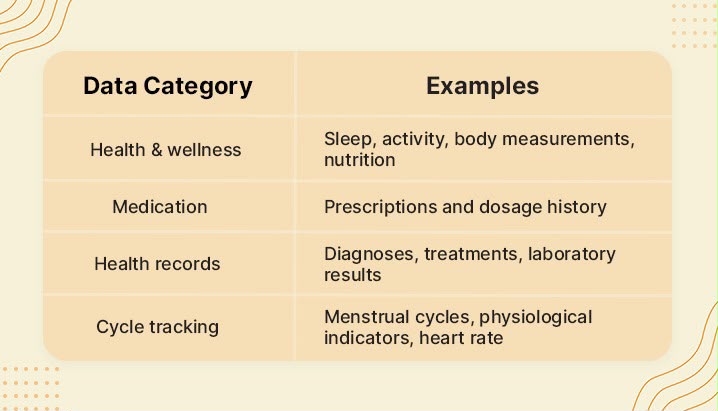
Samsung states this information may be used to improve health algorithms, AI-powered insights and future health features across the Galaxy ecosystem and supported Android devices, while user consent can be withdrawn where required by law. (Samsung)
Unlike search history or shopping preferences, these datasets reveal biological patterns that remain valuable throughout a person's lifetime. That makes consent significantly more consequential.
Today, every major AI platform is competing to build increasingly personalized assistants. Generic language models are no longer enough. The competitive advantage now comes from proprietary datasets. Growth in digital health adoption means AI systems have access to increasingly large volumes of health data, making consent and privacy more important than ever.
Together, they allow AI systems to generate recommendations that feel genuinely personalized rather than statistically average. Samsung's own developer documentation shows its Health platform is built around explicit user permissions, with access controls that users can revoke at any time. Developers must request consent before accessing protected health information. (Samsung Developer)
The bigger privacy question hasn't been answered
Samsung's clarification addressed one immediate concern. It did not answer every important question.
How long are AI-training datasets retained? How extensively are they anonymized before model development? What role does human review play? Could future AI features require broader categories of medical information?
Those unanswered questions surely matter while using health features on your smartphone, but they become even more relevant when planning to upgrade and sell your phone. Whether you wish to trade-in, sell on a buyback platform, or simply pass it to someone in the family, make it a ritual to remove your sensitive health and personal data. Because while getting the best resale value for your smartphone is important, protecting your data stored on it is just as valuable.