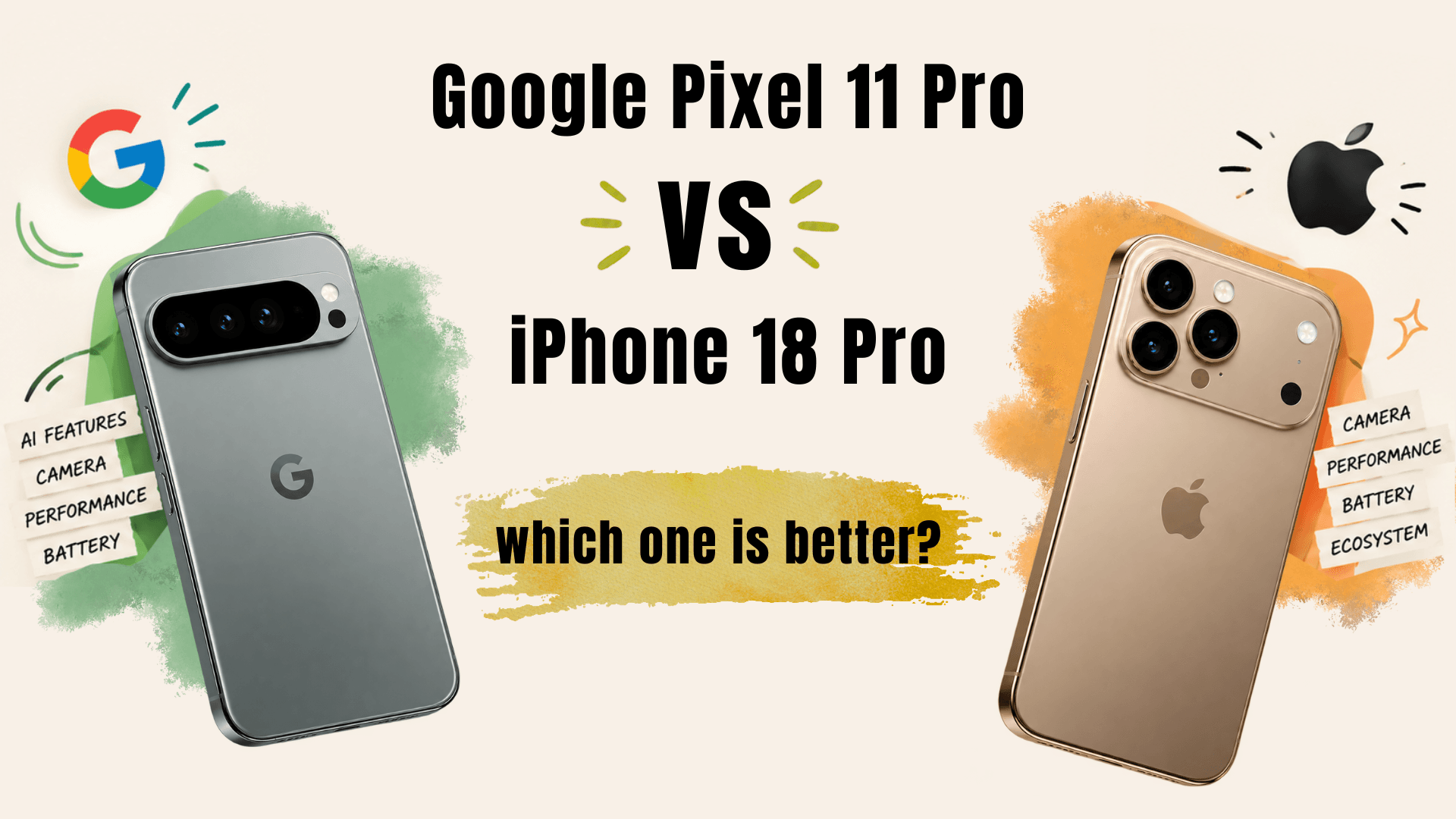
If you are choosing between the Google Pixel 11 Pro and the iPhone 18 Pro in the US, the better phone depends less on raw specs and more on your ecosystem, camera style, AI needs, and upgrade deal. Both phones are officially listed by Google and Apple, so this Pixel 11 Pro vs iPhone 18 Pro price comparison uses confirmed facts, not rumors.
Short answer: Choose Pixel 11 Pro if you want Google-first AI, stronger zoom range on paper, and a lower starting price. Choose iPhone 18 Pro if you want Apple's pro video tools, smooth iOS use, and the most complete Apple ecosystem experience.
Which phone should you buy?
For most Android users, the Pixel 11 Pro is the easier pick. It keeps you in Google's world, starts at a lower US list price, and leans into Gemini Intelligence, Pixel camera tools, and seven years of OS, security, and Pixel Drop updates. Google lists the Pixel 11 Pro from $1,099 before trade-in savings, and the Google Store also shows promo pricing for buyers who qualify. (store.google.com) For most iPhone users, the iPhone 18 Pro is the safer upgrade. It keeps iMessage, FaceTime, AirDrop, Apple Watch, iCloud, Apple Pay, MagSafe accessories, and App Store purchases in place. Apple says iPhone 18 Pro starts at $1,199 in the US, with pre-orders beginning September 12, 2026, and availability beginning September 18, 2026. (apple.com)
Use this shortcut:
- Buy Pixel 11 Pro if you want the lower starting price, Google services, Gemini features, high zoom reach, Android flexibility, and a 6.3-inch Pro phone that keeps you out of iOS.
- Buy iPhone 18 Pro if you want Apple's ecosystem, stronger pro video workflow, Face ID, MagSafe, Apple's safety feature set, and deeper links with Mac, iPad, Apple Watch, and AirPods.
- Wait before buying either if your current phone still works well and your carrier trade-in offer is weak. US phone deals can change fast, especially around launch windows, holidays, and carrier promo cycles.
Decision summary
The Pixel 11 Pro wins on value if you compare list prices. Google's listed starting price is $1,099, while Apple lists iPhone 18 Pro from $1,199 in the US. The $100 gap is not enough on its own to make you switch ecosystems, but it matters if you buy unlocked, avoid carrier plans, or already use Google services every day. (store.google.com) The iPhone 18 Pro wins for buyers who want video creation, Apple sync, and long-term accessory support. Apple's spec sheet includes ProRes video, ProRes RAW, Apple Log 2, Genlock, MagSafe, Qi2 charging, Face ID, and an eSIM-only US design. That makes it a strong pick for creators who edit on Mac or use iCloud Photos and AirDrop. (apple.com) The Pixel 11 Pro wins for buyers who want a phone built around Google AI and smart photo tech. Google lists Gemini Intelligence, Gemini Nano, Gemini Live, Circle to Search, Live Translate, Call Assist, Magic Capture, Camera Coach, Ask Photos editing, and Pro Zoom up to 120x. If your day runs through Gmail, Google Photos, Google Calendar, Google Maps, and Gemini, Pixel is the cleaner fit. (store.google.com)
Quick comparison by buying priority
- Best for Android users: Pixel 11 Pro. You keep Android, Google services, and Pixel camera and AI features without learning iOS.
- Best for Apple users: iPhone 18 Pro. You keep iMessage, FaceTime, Apple Watch, AirPods pairing, iCloud, and Apple's cross-device features.
- Best lower starting price: Pixel 11 Pro. The listed US starting price is $100 below iPhone 18 Pro before promotions. (store.google.com)
- Best for pro video: iPhone 18 Pro. Apple lists ProRes, ProRes RAW, Apple Log 2, Dolby Vision recording, and external recording options. (apple.com)
- Best for long zoom range on listed specs: Pixel 11 Pro. Google lists a 48 MP 5x telephoto camera and Pro Zoom up to 120x, while Apple lists 8x optical-quality zoom in and digital zoom up to 40x. (store.google.com)
- Best for compact Pro sizing: Tie. Both standard Pro models use 6.3-inch displays, though dimensions, weight, hand feel, and interface choices differ. (store.google.com)
Which phone has the better price comparison in the US?
The Pixel 11 Pro is cheaper by official starting price, while the iPhone 18 Pro may become competitive if Apple or a US carrier gives you a stronger trade-in deal. Google lists Pixel 11 Pro from $1,099 and shows a promo example from $619 after eligible trade-in, while Apple lists iPhone 18 Pro from $1,199 or $49.95 per month for 24 months. Apple also says eligible iPhone trade-ins can receive $175 to $885 in instant credit, with select carrier credits reaching up to $1,200 for qualifying trade-ins. (store.google.com) For a fair price comparison, do not look only at the headline monthly payment. In the US, the best advertised phone deals often need a qualifying unlimited plan, device financing, trade-in checks, bill credits over time, or a full-term carrier commitment. A lower monthly payment can cost more if it locks you into a plan you would not have picked.
Consider these value factors before buying:
- Unlocked price: Pixel 11 Pro has the lower confirmed starting price.
- Trade-in value: Apple's iPhone trade-in path may be stronger if you have a recent iPhone, while Pixel promos may be stronger if Google or your carrier is discounting Pixel hard.
- Storage needs: Pixel 11 Pro starts with 256 GB and offers 512 GB and 1 TB options; iPhone 18 Pro starts at 256 GB and offers 512 GB, 1 TB, and 2 TB options. (store.google.com)
- Accessories: iPhone buyers may spend more on MagSafe cases, wallets, and Apple ecosystem accessories; Pixel buyers may spend less if they already use USB-C and Qi-compatible accessories.
- Service costs: Compare AppleCare, Pixel Care+, carrier insurance, repair deductibles, and local repair access before choosing on sticker price alone.
Design, display, and daily handling
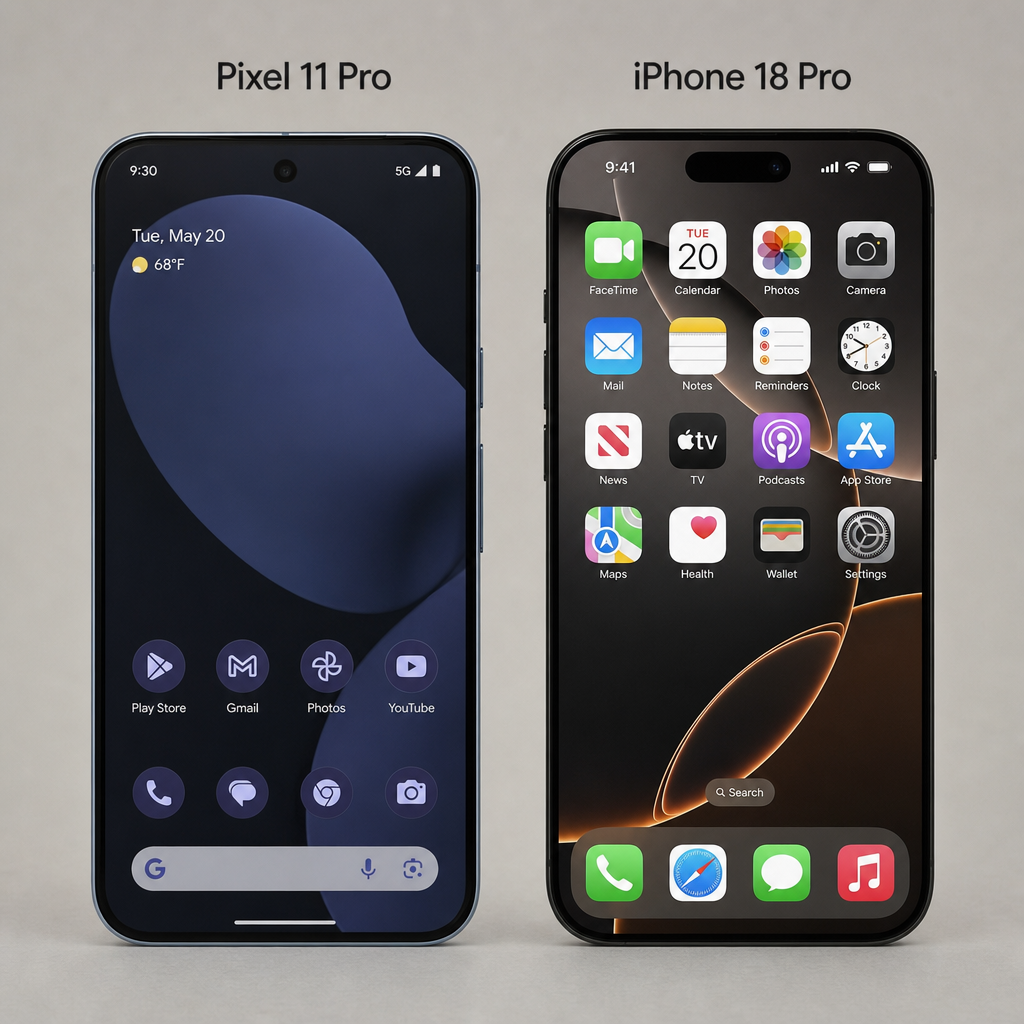
Both phones aim at the premium compact flagship buyer, but they handle design in different ways. The Pixel 11 Pro has a 6.3-inch Super Actua LTPO OLED display with 1-120 Hz Smooth Display, 1280 by 2856 resolution, up to 3600 nits peak brightness, Gorilla Glass Victus 2 cover glass, and a listed weight of 7.2 ounces. The Pixel 11 Pro XL grows to 6.8 inches, but the standard Pixel 11 Pro is the closer match to iPhone 18 Pro. (store.google.com)
The iPhone 18 Pro has a 6.3-inch Super Retina XDR OLED display with ProMotion up to 120 Hz, Always-On display, 2622 by 1206 resolution, 3000 nits peak outdoor brightness, Ceramic Shield 2 front, Ceramic Shield back, and a listed weight of 7.44 ounces. Apple uses an aluminum unibody design and offers black, silver, glacier, and burgundy finishes. (apple.com) In daily use, the main difference is not the screen size. It is the OS and the controls. Pixel gives you Android navigation, Google's home screen flexibility, fingerprint unlock plus face unlock, and Pixel-first search tools. iPhone gives you Face ID, Dynamic Island, the Action button, Camera Control, and Apple's tightly managed iOS interface.
Which camera setup is better for you?
Choose Pixel 11 Pro if you care most about still photos, long zoom reach, Google Photos editing, and AI capture. Google lists a triple rear camera system with a 50 MP wide camera, 48 MP ultrawide with Macro Focus, 48 MP 5x telephoto lens, optical-quality steps at 0.5x, 1x, 2x, 5x, and 10x, plus Pro Zoom up to 120x. It also includes Pixel camera tools such as Magic Capture, Camera Coach, Best Take, Photo Unblur, Real Tone, Night Sight, night-sky shots, and Ask Photos editing. (store.google.com) Choose iPhone 18 Pro if you care most about controlled shooting, video formats, color work, and creator tools. Apple lists a 48 MP Pro Fusion camera system with a variable-aperture 48 MP Fusion Main camera, 48 MP ultrawide, 48 MP telephoto, 8x optical-quality zoom in, digital zoom up to 40x, ProRAW, Photographic Styles 3, and pro controls for aperture, shutter speed, white balance, and histogram. For video, Apple lists 4K Dolby Vision up to 120 fps on the Fusion Main camera, ProRes, ProRes RAW, Apple Log 2, Genlock, spatial video, and four studio-quality microphones. (apple.com)
The practical camera choice looks like this:
- Family photos and quick edits: Pixel 11 Pro is compelling because Google's capture and editing features are built for fixing imperfect everyday shots.
- Social video and pro mobile workflows: iPhone 18 Pro has the stronger listed creator toolkit, especially if you use Mac-based editing.
- Zoom-heavy travel and events: Pixel 11 Pro has the bigger listed digital zoom number, though real-world quality will depend on light, distance, and processing.
- Manual photo control: iPhone 18 Pro's variable aperture and pro controls give it a clear creative angle for users who want to tune capture settings.
Performance, AI, and software experience
The Pixel 11 Pro uses Google Tensor G6 with the Titan M3 security coprocessor, and Google positions the phone around Gemini Intelligence. Its feature list includes Gemini Nano, Gemini Live, Gemini apps, Circle to Search, Live Translate, Call Assist, and Google's Pixel camera intelligence. Google also lists seven years of OS, security, and Pixel Drop updates, which is a strong long-term support promise for Android buyers. (store.google.com) The iPhone 18 Pro uses Apple's A20 Pro chip with a 6-core CPU, a 7-core GPU, a Dual 16-core Neural Engine, and hardware-accelerated ray tracing. Apple says iPhone 18 Pro includes iOS 27 with the next generation of Apple Intelligence and Siri AI, with Siri AI rolling out in beta. That wording matters: the hardware is official, but some AI features may change after launch based on language, region, software updates, and Apple's rollout schedule. (apple.com) For US buyers, the software choice is often simple. If you live in Google Workspace, Gmail, Google Photos, Google Assistant or Gemini, and Android tweaks, Pixel feels natural. If your household uses iMessage groups, shared iCloud albums, Apple Cash, AirDrop, FaceTime, Find My, Apple Watch, or Mac, iPhone removes friction every day.
Battery, charging, and connections
Google lists 30+ hour battery life for both Pixel 11 Pro and Pixel 11 Pro XL, with the standard Pixel 11 Pro using a typical 4850 mAh battery. The Pixel 11 Pro supports fast charging up to 55% in about 30 minutes with a 30W USB-C PPS charger or higher, sold separately, and Pixelsnap wireless charging up to 25W. (store.google.com) Apple lists iPhone 18 Pro at up to 24 hours of typical use and up to 36 hours of video playback, while iPhone 18 Pro Max reaches up to 30 hours of typical use and up to 45 hours of video playback. The iPhone 18 Pro can charge up to 50% in about 15 minutes with a compatible 60W-capable adapter or higher, sold separately, and supports MagSafe and Qi2 wireless charging up to 25W. (apple.com) Connections are close on paper. Both families list Wi-Fi 7, Bluetooth 6, NFC, ultra-wideband support, USB-C, 5G sub-6, and mmWave support for relevant US models. Both also use dual eSIM, and Apple says iPhone 18 Pro and iPhone 18 Pro Max do not work with physical SIM cards. (store.google.com)
Pros and cons
Pixel 11 Pro pros
- Lower official US starting price than iPhone 18 Pro.
- Strong Google AI focus with Gemini Intelligence, Gemini Live, Circle to Search, Live Translate, and Call Assist.
- Seven years of OS, security, and Pixel Drop updates.
- Triple rear camera system with 50 MP wide, 48 MP ultrawide, 48 MP 5x telephoto, and Pro Zoom up to 120x.
- Fingerprint Unlock and Face Unlock, which give users more sign-in options.
- Deep links with Google Photos editing features such as Ask Photos, Magic Eraser, Photo Unblur, Best Take, and Zoom Enhance. (store.google.com)
Pixel 11 Pro cons
- Switching from iPhone means losing native iMessage, FaceTime, AirDrop, Apple Watch pairing, and some Apple ecosystem perks.
- The listed 1 TB maximum storage is lower than the iPhone 18 Pro's listed 2 TB maximum.
- Some of Pixel's best perks depend on how much you use Google services.
- Long digital zoom numbers do not mean every zoomed photo will beat a lower-zoom shot in real use.
iPhone 18 Pro pros
- Excellent fit for Apple users who already rely on iMessage, FaceTime, Apple Watch, AirPods, iCloud, Apple Pay, and Mac.
- Strong listed pro video toolkit, including Dolby Vision, ProRes, ProRes RAW, Apple Log 2, Genlock support, and external recording options.
- Variable-aperture 48 MP Fusion Main camera adds real creative control for stills.
- Storage options go up to 2 TB.
- Apple's satellite safety features include Emergency SOS, Roadside Assistance, Messages, and Find My via satellite.
- MagSafe and Qi2 support give iPhone buyers a mature magnetic accessory system. (apple.com)
iPhone 18 Pro cons
- Higher official US starting price than Pixel 11 Pro.
- US models are eSIM-only, which may be inconvenient for users who still prefer physical SIM cards.
- Siri AI is described by Apple as rolling out in beta, so buyers should expect some AI features to mature over time.
- Switching from Android can mean replacing paid apps, changing cloud habits, and adapting to iOS limits around custom tweaks.
Use-case recommendations
Pixel 11 Pro is better for these users
Pixel 11 Pro is the better fit for Android loyalists, Google Photos users, frequent travelers who want built-in translation tools, and buyers who want the lower starting price without giving up a premium screen, flagship camera system, and long software support. It is also the stronger choice if your phone is a daily Google command center: searching, navigating, screening calls, editing photos, managing Gmail, and using Gemini across tasks.
It is especially easy to recommend if you are coming from an older Pixel. You avoid the pain of switching platforms, keep familiar Pixel camera behavior, and may be able to take advantage of Google Store or carrier trade-in offers. Just confirm the final price at checkout because promotional credits, financing, and trade-in estimates can depend on device condition and whether you qualify.
iPhone 18 Pro is better for these users
The iPhone 18 Pro is the better fit for iPhone owners, Apple Watch users, mobile filmmakers, creators who edit on Mac, families built around iMessage and FaceTime, and buyers who prefer Apple's privacy and ecosystem approach. Its biggest advantage is not one isolated spec; it is the way the hardware, iOS, accessories, services, and other Apple devices work together.
It is especially compelling if you shoot a lot of video. Apple's listed support for ProRes RAW, Apple Log 2, Dolby Vision, Genlock, spatial video, and four studio-quality microphones gives it a creator-focused edge that Pixel does not match on its spec sheet. If those terms mean nothing to you, Pixel may give you more clear everyday value for the money.
Final verdict
The Pixel 11 Pro is better for value-focused Android buyers and Google-first users. It starts $100 lower in the US, offers extensive Gemini and Pixel camera features, and provides long software support. In the pixel 11 pro vs iphone 18 pro choice, it is the practical pick for people who want premium hardware without leaving Android.
The iPhone 18 Pro is better for Apple users and mobile creators. It costs more at the official starting price, but it offers Apple's ecosystem, polished hardware-software integration, and a more advanced listed video toolkit. If you already own an Apple Watch, Mac, iPad, or AirPods, the iPhone 18 Pro is likely the better long-term purchase.
Before you buy, compare the final unlocked price, carrier bill credits, trade-in value, storage tier, protection plan, and required service plan. The best phone is the one that gives you the lowest total cost without forcing you out of the ecosystem you actually use every day.
FAQs:
1. Is the Pixel 11 Pro always the better buy because it starts $100 cheaper?
No. The Pixel 11 Pro has the lower official US starting price, which makes it the stronger value pick for many Android and Google-first buyers. But the $100 gap is small next to the cost of switching ecosystems, replacing accessories, changing cloud services, or losing features like iMessage, FaceTime, AirDrop, Apple Watch support, and existing App Store purchases.
2. Which phone is better for camera use?
It depends on what you shoot most. The Pixel 11 Pro is better for still photos, AI edits, Google Photos tools, and long zoom range on listed specs. The iPhone 18 Pro is stronger for video creators because it lists ProRes, ProRes RAW, Apple Log 2, Dolby Vision, Genlock support, spatial video, and four studio-quality microphones.
3. Should iPhone users switch to Pixel 11 Pro for Google AI features?
Only if Google services and Gemini features matter more than Apple ecosystem convenience. Pixel 11 Pro is built around Gemini Intelligence, Circle to Search, Live Translate, Call Assist, and Pixel camera tools. But iPhone users who rely on Apple Watch, iMessage groups, FaceTime, iCloud, AirDrop, Mac, or AirPods will likely find the iPhone 18 Pro easier to live with every day.
4. Which phone is better for long-term ownership?
Both can be strong long-term phones, but for different reasons. Pixel 11 Pro offers seven years of OS, security, and Pixel Drop updates, which is excellent for Android buyers. iPhone 18 Pro may be better for long-term Apple users because of Apple ecosystem fit, MagSafe accessory support, the higher 2 TB storage option, and tight links with Apple services and devices.
5. What should US buyers check before choosing either phone?
Check the final out-of-pocket cost, not just the starting price or monthly payment. Compare trade-in value, carrier bill credits, required unlimited plan, financing terms, storage tier, protection plan, repair costs, and whether the deal locks you to a carrier. A cheaper advertised offer may cost more overall if it needs a service plan you would not otherwise pick.