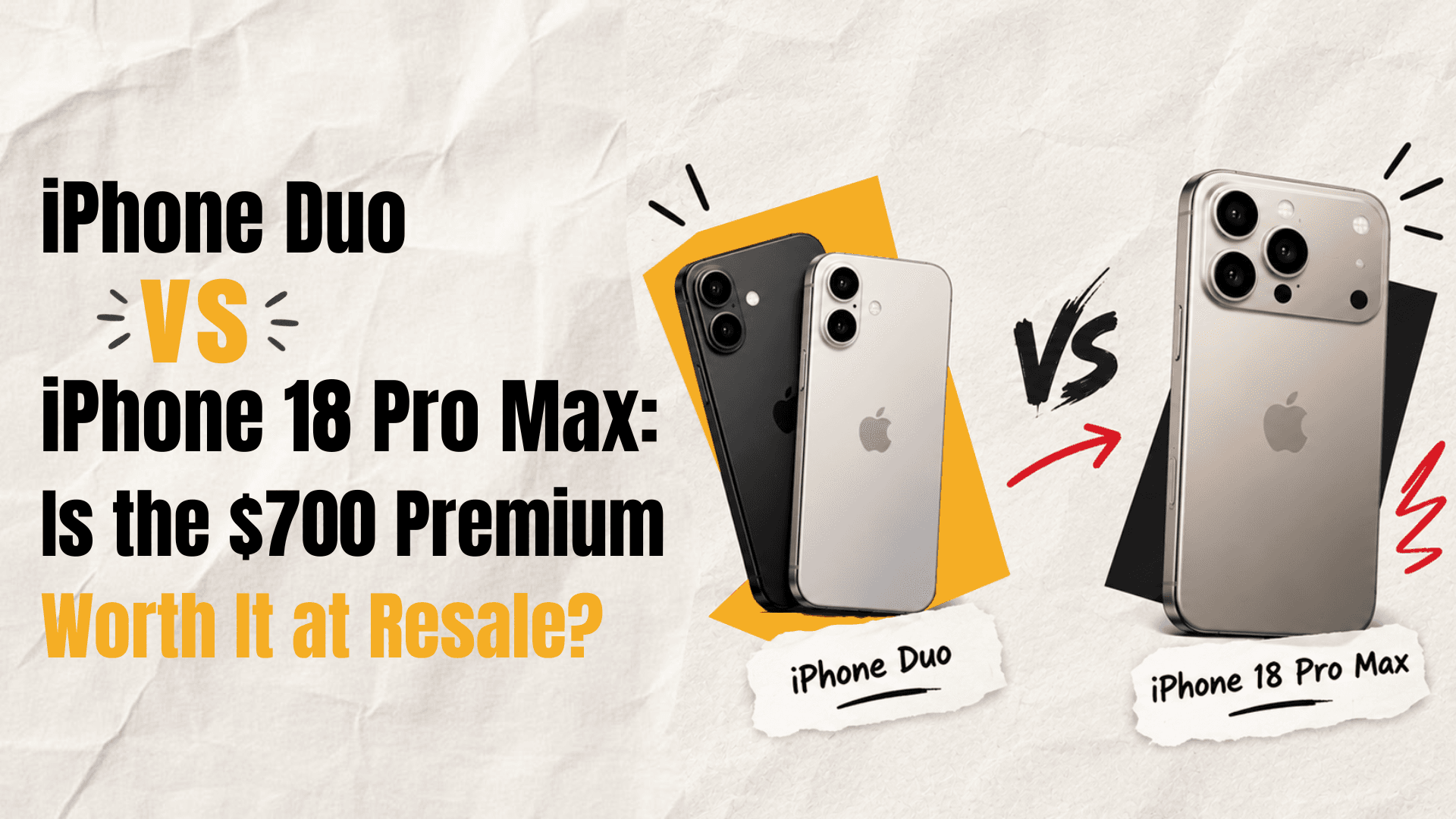
The iPhone Duo starts $700 higher than the iPhone 18 Pro Max, offering a larger display and the same A20 Pro chip. But the upfront price is only part of the ownership equation. Insurance, repair costs, and future resale value can all affect how much that $700 premium actually costs over time.
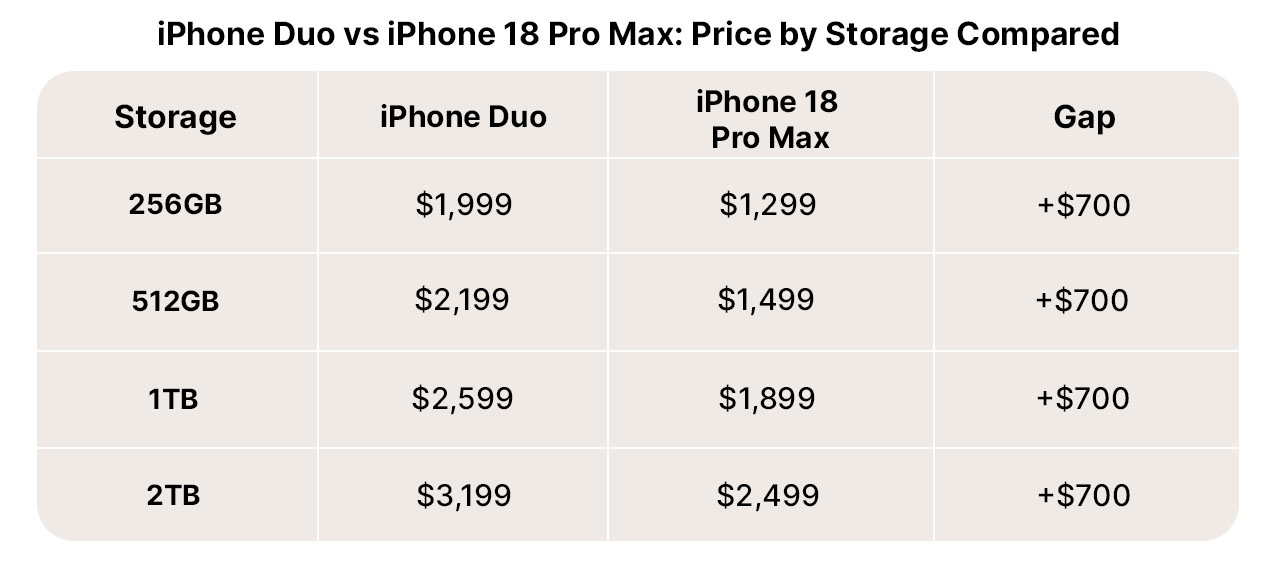
The $700 price gap remains the same across every storage tier, but the percentage premium becomes smaller at higher capacities. The Duo is approximately 54% more expensive than the Pro Max at 256GB, 47% at 512GB, 37% at 1TB, and 28% at 2TB.
Apple's Trade-in program is a separate consideration. Paying more for higher storage does not necessarily translate into an equivalent increase in trade-in value, so buyers should factor resale and trade-in estimates into the total cost rather than assuming the additional storage spend will be recovered later.
That raises the bigger question: does the Duo's higher purchase price also mean higher long-term ownership costs?
AppleCare+ and repair costs: where the Duo gets expensive
These costs can be classified into two types.
- Recurring cost - AppleCare+ coverage for theft and loss protection for the Duo device costs $199.99 annually or $19.99 monthly. This cost represents a difference of $50 annually, which amounts to 33% more than the Pro Max plan of $149.99, on top of the purchase premium of $700.
- Risk cost - In case the screen breaks, the difference becomes even bigger. Experts estimate that repairing the inner display of the Duo out of warranty could cost approximately $1,150, much higher than the average repair prices of flat-screen iPhones. The folding screen is a primary reason for such a high cost. Under AppleCare+, the company charges $99 for repairing the inner display of the Duo device, versus $29 for repairing the flat-glass iPhone.
The $1,150 is an educated estimate before the launch of the Duo. Apple has not released any data on the out-of-warranty price of the Duo.
What this means for resale value
Here, ownership calculations would be most important for those planning on trading or selling the phone, rather than keeping it.
While there is a relatively established used market for the Pro Max, with more predictable depreciation rates, repair costs, and consumer trust, the Duo does not enjoy such an advantage. First-generation foldable phones have historically depreciated faster than regular phones, mainly because of problems related to the hinge, foldable screens, and longevity. It is harder to justify paying over $1,150 for a repair that is not covered by Apple’s warranty when compared with paying $29 for a screen repair.
Another factor about which not enough is known yet is battery life. While the Duo divides the battery into two cells because of the hinge, it is unclear whether the two batteries will degrade at the same rate as the battery in a regular phone.
How to get the best trade-in value, whichever phone you choose
The most important variable influencing your earnings is time and place of sale:
- Sell the phone prior to the next product launch. News about a new model automatically devalues the old one, and depreciation starts to speed up after that.
- Get and compare at least several estimates. Buyback websites usually give better remuneration since they take into account storage, condition, and demand. They pay cash.
- Calculate the cost of your iPhone first. Use an online depreciation calculator like Cashmycell’s depreciation calculator for both versions before making the purchase.
- Determine the condition yourself. Apple’s trade-in doesn’t take the condition into account, while the buyback websites do.
- Do not throw away a cracked screen. Apple won’t take any phone with damages, while the buyback websites do take it, and this might save you a four-digit figure, especially for the Duo.
Who should actually buy the Duo vs the Pro Max?
When upgrading every one or two years, the Pro Max is the more financially attractive option. It offers a reduced price, less expensive AppleCare+, and more experience with repairs and resales through past generations.
If the foldable format of the Duo is what drives the decision to buy it, be it due to multitasking, media consumption, or something entirely new for an iPhone, the choice can certainly make sense. However, be aware of the total expenses that come with it: an additional $700 up front, an extra $50 per year for AppleCare+, and potentially $700+ for a repair out of warranty.
Bottom line
“$700 more” is just the first step. Once we take into account the extra cost of AppleCare+ and an inner-screen repair that could cost several times more than a Pro Max screen repair, along with the undetermined resale value of a first-generation phone, the difference could amount to at least $1,000 in case you need a screen replacement.
Identify your needs and find out first how much your current phone is worth.
Cashmycell’s depreciation calculator can also provide resale-value estimates for both the iPhone Duo and iPhone 18 Pro Max, helping you compare how their values could change over time. Since these are projections for a new product, they should be treated as estimates rather than actual resale prices.
Methodology
The iPhone Duo and iPhone 18 Pro Max prices mentioned in this article refer to Apple Inc.'s official U.S. list prices, as advertised. Prices and fees related to AppleCare+ are based on prices and fees made public by Apple Inc. Out-of-warranty repair costs are rough estimates based on information from independent repair providers and industry sources, rounded to the nearest $50.
The repair cost figures were obtained before the Duo was released and have not been verified by Apple Inc. Resale and trade-in value estimates are based on observed depreciation trends for first-generation products compared with established products, using data from flat-screen iPhones due to the lack of information about the Duo's resale value at the moment.
FAQs
1. Would a higher storage version of the iPhone Duo get a better trade-in from Apple?
No, the price that Apple offers through its Trade In program is the same for all storage versions of the phone: whether a 256GB or a 2TB Duo, they receive equal credits.
2. Why does AppleCare+ for Duo cost more, and is it worth paying extra for?
The reason could be that the folding screen is a more costly and vulnerable element compared to other iPhones. With the estimated out-of-warranty repair costs amounting to over $1,150, it might be worth purchasing AppleCare+ for Duo.
3. Will the iPhone Duo retain its resale value compared to the Pro Max?
Definitely not right away. The device is a first-gen foldable phone, lacking the repair history and reliability that helps the Pro line hold value, and any buyback will take that into consideration.
4. Does the $700 price difference narrow as you increase storage capacity?
Only as a percentage of the total cost. It's always $700 apart, whether it's 256GB or 2TB.
5. Is it better to trade-in with Apple or to use a buyback marketplace to sell?
Generally the latter pays more, because they take into account storage capacity, condition, and demand, and they're paying in cash not store credit. Plus, the offers on the same model can vary $100 or more between different buybacks.
6. Will I still be able to sell my cracked iPhone Duo for money?
Yes, because buyback companies will offer to buy the device, even if it is damaged, which is more advantageous than spending a four-figure price to fix it.
7. When is it better to sell: before or after the next Apple event?
Better before, if you can afford it. Value goes down once a new generation of the product is announced, and further once released.
8. Are the Duo batteries foldable and degrading faster than a regular iPhone battery?
Unknown so far, As the Duo has divided its battery into two cells in order to accommodate the hinge, there is no information yet on how long such a battery lives in comparison to the regular flat-phone battery.
9. Is the Duo worth purchasing if you upgrade your phone every year or two?
Perhaps, but not as good as the Pro Max because of a higher initial cost and higher cost of annual AppleCare+, as well as resale value problems associated with being a first-generation device.
10. Should I wait until the second generation of the Duo or buy the first generation?
This is something you should think about if the value of your product in case of resale and the cost of repair become a greater concern for you than the latest model of the product.