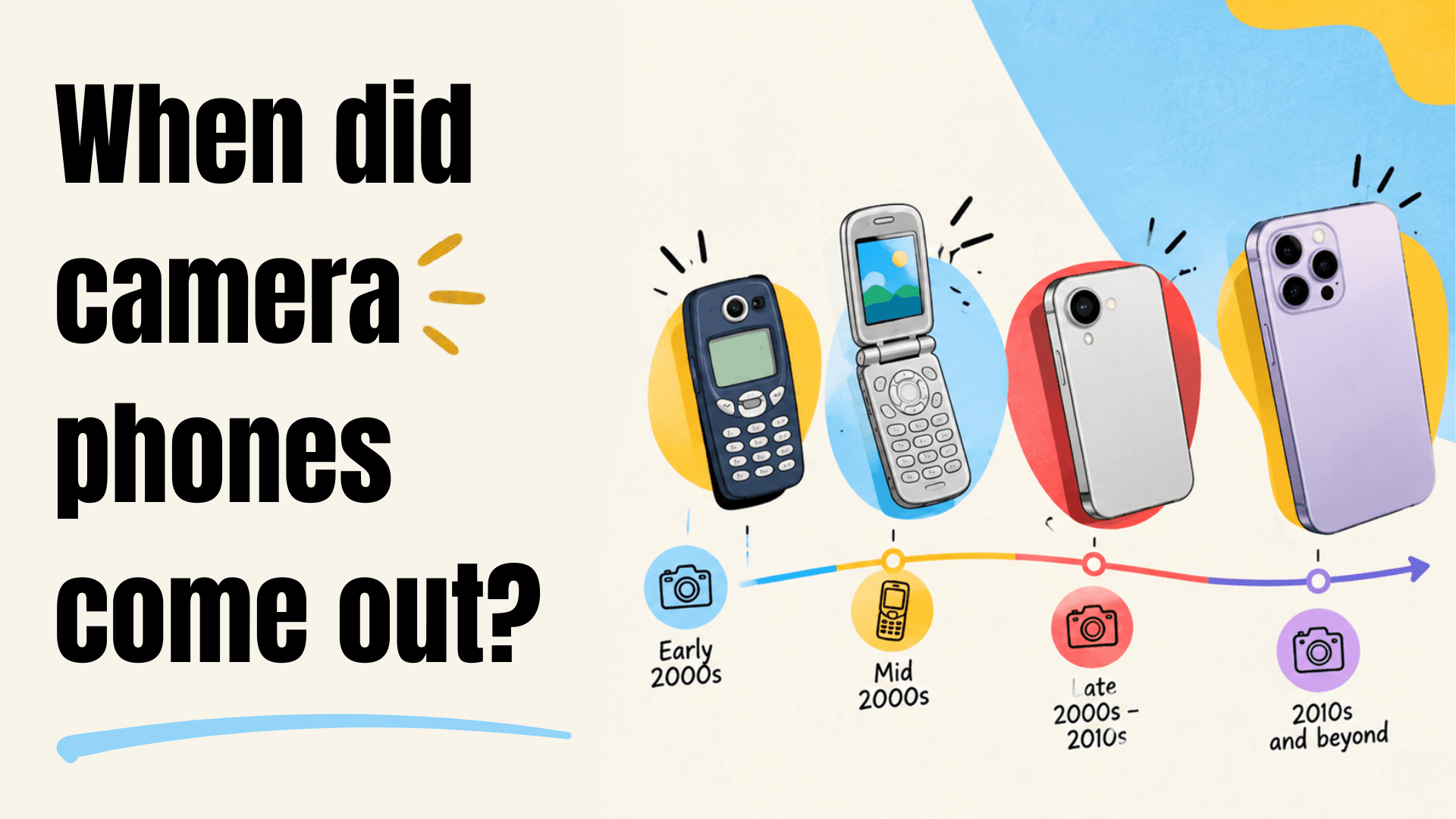
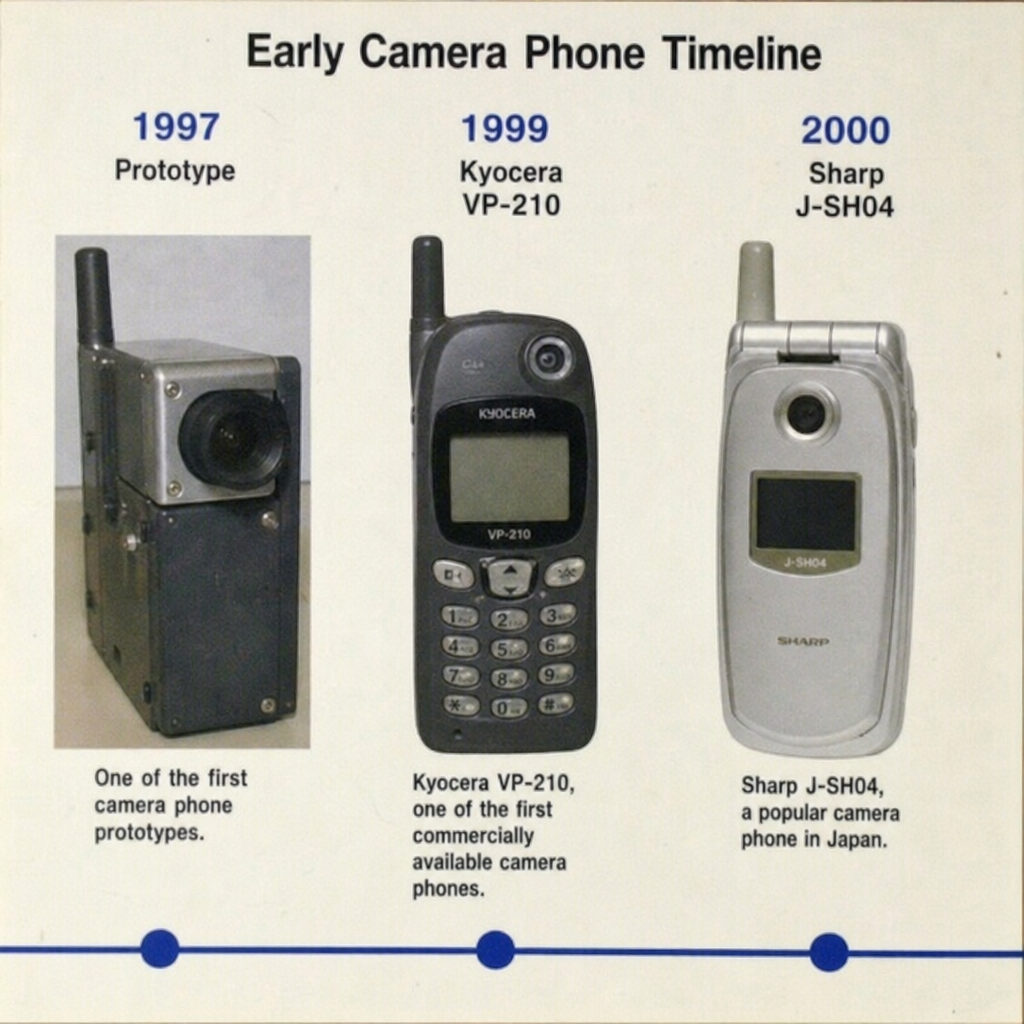
Camera phones came out commercially in Japan in 1999, when Kyocera released the Visual Phone VP-210. The broader cultural shift followed in 2000 with Sharp’s J-SH04, a J-Phone handset that made taking and sending photos from a mobile device feel practical for everyday users. In the United States, integrated camera phones arrived later, with Sprint and Sanyo announcing the Sanyo 5300 in 2002 as a U.S. first. (comsoc.org)
That timeline matters because the phrase “first camera phone” can mean different things. Some people mean the first working concept, others mean the first mobile with camera hardware built in, and others mean the first phone that made mobile photo sharing easy enough for regular consumers. The story becomes much clearer when those milestones are separated instead of forced into one winner.
The invention began with an instantly shared photo
Before shoppers could buy the first cell phone with a camera, software entrepreneur Philippe Kahn created a working mobile photo-sharing system in 1997. According to Kahn’s account, he connected a digital camera, a mobile phone, a laptop, and server software so he could share a photo of his newborn daughter, Sophie, on June 11, 1997. This was not a sleek consumer handset, but it was a powerful demonstration of the idea behind the first mobile phone camera experience: capture a moment and send it instantly. (philippekahn.com)
That distinction is important. Kahn did not simply attach a camera for storage; he focused on communication. The image was meaningful because it moved quickly from one personal moment to a wider circle of people. In hindsight, that is exactly what made camera phones revolutionary: they turned photography from an activity you planned into something you could do, send, and react to in the same moment.
Kahn’s prototype also explains why the history of the first camera phone invented is more than a hardware story. The camera, network, software, and sharing behavior all had to come together. A lens alone was not enough; the breakthrough was the combination of image capture and mobile distribution.
Which device was the first camera phone?
The first commercially available camera phone is widely identified as the Kyocera Visual Phone VP-210, released in Japan in 1999. However, Sharp’s J-SH04 is often called the first successful mass-market camera phone because it paired a built-in camera with a mobile service designed for sending pictures. If you are searching for the 1st cell phone camera, Kyocera is usually the commercial starting point, while Sharp is the mainstream adoption milestone. (comsoc.org)
The Kyocera VP-210 was marketed around visual communication and included a front-facing camera, a concept that now feels surprisingly modern. It showed that a handset could include imaging as part of its core design, not just as an accessory. Still, its place in history is sometimes debated because later models made still-photo sharing more central to the user experience.
Sharp’s J-SH04, sold by J-Phone in Japan in 2000, is remembered because it helped define what people expected from a camera phone. Sharp describes the J-SH04 as an industry-first camera-equipped mobile phone, and other mobile-history sources treat it as the world’s first cellular-enabled camera phone because users could capture and send images directly from the device. (global.sharp)
Samsung’s SCH-V200, released in Korea in 2000, is another important contender. It included a camera in the handset body, but its photo workflow was less integrated because images had to be transferred to a computer before being shared. That is why many histories mention Samsung but still give Kyocera or Sharp the stronger claim, depending on whether “first” means camera hardware, commercial availability, or complete mobile sharing.
A simple timeline of the first mobile with camera
The easiest way to understand the birth of the first camera phone is to follow the milestones in order. Each step added something essential: the idea, the commercial product, the messaging experience, and finally wider adoption outside Japan.
- 1997: Philippe Kahn’s prototype proves instant mobile photo sharing. The system was improvised, but the concept was clear: take a digital photo and transmit it through a mobile network almost immediately. (philippekahn.com)
- 1999: Kyocera VP-210 reaches consumers in Japan. This is the key answer for “when did camera phones come out” if the question means commercial release. (comsoc.org)
- 2000: Samsung SCH-V200 adds camera hardware in Korea. It helped push the idea of a camera-equipped handset, even though photo sharing was not as seamless as later models.
- 2000: Sharp J-SH04 popularizes the integrated camera-phone experience. Its ability to take and send photos from the phone made it a landmark first mobile with camera for everyday communication. (global.sharp)
- 2002: Sanyo 5300 brings the idea to U.S. consumers. Sprint and Sanyo announced it as the first U.S. mobile phone with an integrated digital camera. (phonescoop.com)
This timeline shows why the first camera phone invented is not a one-name trivia answer. It is a chain of inventions and releases, each solving a different part of the same problem. The technology became important only when the phone could fit into real social behavior: capture, send, receive, and respond.
Why the first mobile phone camera mattered
At first, putting a camera in a phone sounded like a novelty. Early camera quality was limited, screens were small, and mobile networks were nowhere near as fast or flexible as they are today. But the value was never only about image quality. The real benefit was convenience: the best camera became the one already in your pocket.
That changed the role of photography. Before the first mobile phone camera, casual photos often depended on carrying a dedicated camera and remembering to develop, upload, or transfer images later. Camera phones collapsed those steps. A meal, a broken appliance, a concert poster, a classroom note, or a child’s first steps could be captured without planning.
It also changed communication itself. A picture could replace a long explanation: “Here’s where I am,” “This is the part I need,” “Look what just happened.” That practical, everyday usefulness is why the first cell phone with a camera eventually mattered far beyond tech enthusiasts.
The early limits made the success more surprising
The first camera phones were nowhere near today’s mobile cameras. They produced small images, offered limited storage, and worked within the constraints of early mobile data services. Yet those limits may have helped people understand the format. These were not meant to replace professional cameras; they were meant to make quick visual communication possible.
That explains why Japan became such an important launch market. Japanese mobile services were already experimenting with mobile internet features, messaging, and compact devices. Camera phones fit naturally into that environment because the phone was becoming a personal media tool, not just a voice device.
For consumers, the appeal was emotional as much as technical. A grainy photo sent immediately could feel more valuable than a sharper image shared days later. The first camera phone proved that speed, presence, and context could matter as much as resolution.
What the first camera phones taught the tech world
Looking back, the earliest camera phones predicted several habits that now define digital life. They made visual sharing casual, constant, and personal. They also showed manufacturers that people wanted phones to absorb other everyday tools, from cameras and music players to maps and wallets.
As smartphones continue to evolve, the value of a device is shaped by more than its features at launch. Factors such as new model releases, changing consumer demand, and depreciation can all influence what a phone is worth over time. Cashmycell’s depreciation calculator helps consumers track these resale trends and understand how their device’s value changes as the market moves.
A few lessons stand out:
- Integration beats attachment. Users preferred a camera built into the device they already carried over a separate accessory.
- Sharing is part of the product. The strongest camera-phone experiences connected capture with sending, not just saving.
- Convenience can outweigh perfection. Early photos were low quality, but they were immediate and useful.
- Behavior changes before quality peaks. People adopted camera phones before they became technically excellent because the new habit was compelling.
Those lessons still shape mobile technology. Modern smartphone cameras rely on advanced sensors, software processing, cloud backup, and social apps, but the original promise remains familiar: see something, capture it, and share it.
The legacy of the first camera phone
Today, it is easy to forget that the camera was once an unusual feature on a phone. Now it is one of the main reasons people choose a device. Product launches often emphasize lenses, night modes, portrait effects, video stabilization, and editing tools because mobile photography has become central to how people document their lives.
The birth of the first camera phone also reshaped public life. News events, family milestones, accidents, recipes, receipts, workouts, and everyday observations became easier to record. That created new opportunities for creativity and connection, but it also introduced new questions about privacy, consent, and the constant presence of cameras.
The first camera phone was more than a gadget milestone. Philippe Kahn’s 1997 prototype showed the dream, Kyocera’s VP-210 brought the first commercial camera phone to market, and Sharp’s J-SH04 helped turn the idea into a mainstream habit. Together, they created the foundation for the visual, always-shareable mobile culture we now take for granted.
For more insights on smartphone value, resale trends, and what your device could be worth over time, explore Cashmycell.