A carrier trade-in deal can look like easy money for a new phone, but the real value depends on the fine print. The ad often shows the max promo credit, not your device's cash trade-in value. To judge the offer, compare the credit, the plan rules, the payment schedule, and what you give up by trading in elsewhere.
Is a $1,000 Carrier Trade-In Deal Really Worth $1,000?
Usually, a $1,000 carrier trade-in deal only pays the full $1,000 if you meet every rule and stay long enough to get all the credits. In many cases, the offer comes as monthly bill credits over a device payment term, not as an instant discount. If you leave early, switch to a wrong plan, or pay off the phone in a way that hurts the promotion, you may lose part of the advertised benefit.
That does not mean these deals are bad. For the right person, a carrier trade-in program can be a smart way to upgrade with less upfront cost. The catch is that the number in the ad is not the only number that matters. A deal that looks generous can become less useful if it needs a pricier plan, ties you to a long payment period, or gives you less freedom than selling the phone yourself.
The better question is not just how big the offer is. It is how much usable value you really get after all the rules are counted.
The advertised credit is not the same as cash value
The phrase up to $1,000 is doing a lot of work. It usually means the top promotional credit for eligible customers, eligible devices, and eligible plans. Your phone may qualify for the full amount, a smaller amount, or only its normal trade-in value.
Cash value is simple: you give up a device and get money or an instant credit. Promotional value is different. A carrier may give your old phone a base trade-in value, then add promo credits to make the offer look much larger. Those extra credits are often conditional.
For example, imagine your old phone has a standard trade-in value of $250. A carrier might show a total credit of $1,000 if you buy a specific new phone, finance it through the carrier, and keep a qualifying unlimited plan. The extra $750 is not the market value of your device. It is an incentive to stay with the carrier under the promotion's terms.
That difference matters because promotional credit works differently from cash in your pocket. You may not be able to use it for accessories, another bill, another carrier, or a different purchase. It has value, but only inside the carrier's system.
Before accepting a carrier credit, check what your phone is actually worth in cash on Cashmycell, you might find that selling directly to a verified buyer pays more than the carrier's base trade-in value, without the plan strings attached.
How carrier trade-in value is usually calculated
Carrier trade-in value usually has two parts: the device's base value and the promo bonus. The phone itself is tied to the base value. The promo bonus is tied to the carrier's offer.
Several factors can affect the base value:
- Model and storage: Newer, higher-end phones usually get better offers than older or basic devices.
- Condition: Cracks, battery problems, screen damage, or activation lock issues can cut your odds or value.
- Carrier rules: Some offers accept damaged devices, while others want the phone to work fully.
- Timing: Trade-in values often change when new phones launch or promotions end.
- Account status: The phone may need to be paid off, unlocked, or free of security locks before it can be accepted.
The promo side can matter even more. A carrier may give the top credit only when you add a new line, switch from another provider, choose a premium plan, or buy a specific device. Existing customers may see different terms than new customers. Two people trading in the same phone can get very different results depending on their plans, accounts, and upgrade choices.
This is why it helps to separate the value of your phone from the value of the promotion. Your phone's value can differ between resale, trade-in, and carrier promotions.
To see what your device is worth outside the carrier system, compare cash offers for your iPhone or Samsung on Cashmycell. Multiple verified buyers compete, so you see the real market value in seconds.
The monthly credit trap
One of the most common myths is assuming the full trade-in credit comes off the price right away. Many carrier deals spread the credit across monthly bills. That can make the upgrade feel cheaper, but it also changes the real value of the offer.
If a $1,000 credit is spread over a long payment term, you only get the full amount by staying through the full term and meeting the promotion's conditions the whole time. If you cancel service or switch carriers before the credits end, the remaining balance on the new device may become due, and the rest of the promo credits may disappear.
That does not always make the deal unfair. The carrier is giving you a discount in exchange for your continued service. But it does mean the trade-in program works partly like a retention offer. You are not just selling an old phone; you are agreeing to a longer tie to the carrier.
Before you accept, ask yourself whether you would keep the same carrier and plan even without the promotion. If yes, monthly credits may not bother you. If no, the deal may be less flexible than it looks.
What should you check before accepting a trade-in program?
Consider the new phone cost, plan requirements, credit schedule, trade-in rules, and cancellation consequences before trading in. A high advertised credit can still be worth it, but only if the terms match how you use your phone and manage your account.
A practical checklist can keep you from focusing on the headline number alone:
- Confirm your exact device eligibility. Do not assume your model qualifies for the top offer. Check storage size, condition rules, and whether the phone must power on.
- Compare plan costs. If the deal needs a more expensive plan, calculate the extra monthly cost over the full credit period.
- Look at the payout method. Find out whether the credit is instant, a bill credit, a prepaid card, or a mix.
- Check the device payment term. A longer credit schedule can make the offer less flexible.
- Ask about early payoff rules. Some promotions change if you pay off the new phone early.
- Review cancellation consequences. Know what happens if you switch carriers, downgrade the plan, or remove the line.
- Document the trade-in condition. Take photos or video of the phone before you send it in, including the screen, body, serial number, and reset status.
- Save the offer details. Keep screenshots or copies of the promotion terms in case a billing issue shows up later.
These steps may seem tedious, but they shield you from unexpected expenses. The best time to learn the rules is before your old phone is gone.
The plan requirement can change the math
A trade-in deal is not just about the phone. It is often tied to the service plan, and that is where the real cost can hide. If the promotion needs a higher-tier plan than you already use, the extra monthly charge may cut or even erase part of the benefit.
Consider a simple example. Suppose a customer can get a larger trade-in credit by moving to a premium plan. If that plan costs much more each month than the plan they would otherwise choose, the upgrade should be treated as part of the purchase price. Over time, the added service cost can grow larger than the gap between a regular trade-in value and the promotional one.
This is especially important for families and multi-line accounts. A plan change may affect more than one line, not just the phone being upgraded.
Umubare w'ibimenyetso w'igikorwa kigomba kugira uburyo bwo kubaka inyandiko zose zikora. What looks like a phone discount could turn into a higher household bill.
The cleanest way to judge the deal is to compare two full scenarios: staying on your current plan without the promotion versus taking the promotion with all required plan changes. The better deal is the one with the lower total cost and the right level of flexibility, not just the one with the biggest trade-in number.
When the deal can make sense
A carrier trade-in offer can be truly useful when it fits your normal habits. If you're happy with your carrier, have a qualifying plan, and keep the service, you'll save money. In that case, you are not changing your behavior much to get the credit.
These deals can also work well for people who want predictable monthly billing. Instead of selling a phone privately, dealing with buyers, or waiting for marketplace payments, you complete the trade-in through the company handling your upgrade. Convenience has value, especially if you do not want to manage a private sale.
A trade-in program may be a good fit if:
- You were already planning to buy the new phone.
- You were already staying with the same carrier.
- Your current plan already qualifies.
- You do not need an unlocked phone right away.
- You are comfortable getting value through bill credits.
- Your old phone has less resale appeal outside the promotion.
In these cases, the offer may lower the cost of something you were already going to do. That is usually when promotional credits feel most like savings.
When the deal may not be worth it
A large promotional credit becomes less attractive when it pushes you into choices you would not otherwise make. If you need to change plans, add a line, finance a device longer than you want, or stay with a carrier you were thinking of leaving, the offer deserves a closer look.
It may not be worth it if:
- The required plan costs more than you need or want to pay.
- You expect to switch carriers before the credits finish.
- You prefer to buy phones unlocked and keep service flexible.
- Your phone could sell for a strong price elsewhere. For example, compare trade-in offers on Cashmycell, if a verified buyer offers close to the carrier's promotional credit without requiring a plan change or long-term commitment, the cash option may be the better deal.
- You dislike tracking monthly credits and promotion terms.
- The offer depends on conditions you are not sure you can keep.
There is also an emotional trap: the bigger the advertised credit, the easier it is to justify buying a pricier phone. A deal is only a deal if it helps you spend less on something you truly want or need. If the promotion nudges you into a more expensive device, a longer commitment, or a plan upgrade you would not choose, the savings may be more complicated than they look.
Comparing your options gives you the clearest answer
The smartest way to judge trade-in value is to compare choices side by side. You do not need a complex spreadsheet, but you do need to look past the headline offer.
Here is a simple comparison framework:
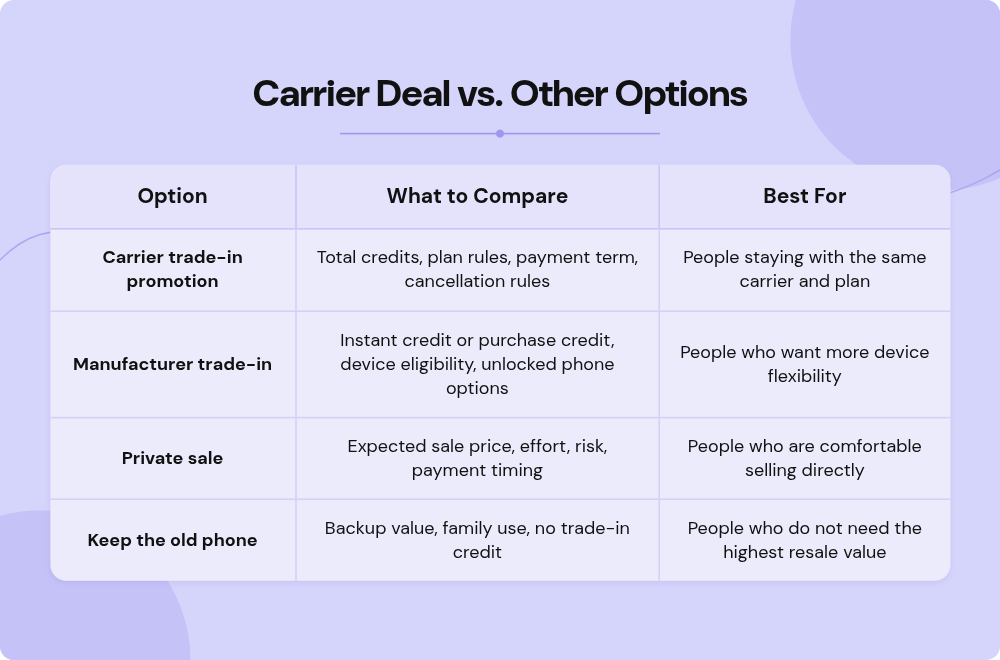
Private selling may bring more cash in some cases, but it also takes time and caution. Manufacturer trade-ins may be simpler and can sometimes work well with unlocked phones. Keeping the phone may make sense for a backup device or to pass it to a family member.
The point is not that one option is always better. The point is that the carrier offer should win on total value, not just on ad appeal.
A simple way to estimate the real value
To get a clearer picture, turn the promotion into a total-cost estimate. Start with the price of the new phone. Subtract the credits you are sure you will actually receive. Then add any extra plan costs, fees, or service changes required by the offer.
Use this simple formula:
Real benefit = credits you will actually receive − added costs required to get them
If the credit is high but you'll leave early, only count the credits you'll actually get. If the plan requirement adds a monthly cost, include that cost across the same period. If you would choose that plan anyway, then it may not count as an added cost.
This approach makes the choice more personal. A deal that is great for one customer can be weak for another because their plans, habits, and timing are different.
Fine print is part of the offer
It is tempting to treat the fine print as a roadblock between you and the deal. In reality, the fine print is the deal. It explains what the carrier is actually offering, when the value arrives, and what you must do to keep it.
Pay close attention to deadlines. Trade-in programs often require you to send the old phone within a set window after you receive the new one. Missing that window can reduce or cancel the promotion. You should also make sure the device is erased, unlocked from account security features, and packed as instructed.
If you trade in at a store, ask for a receipt that shows the device details and the promotion. If you mail the phone, keep tracking information and proof of condition. Most trade-ins go smoothly, but records give you leverage if something is misapplied.
The takeaway for shoppers
A $1,000 carrier trade-in deal can be worth close to $1,000, but only for customers who qualify for the full promotion and stay within the rules long enough to get every credit. For everyone else, the real value may be lower than the headline number.
Before you hand over your phone, separate the device's actual trade-in value from the carrier's promotional credit. Compare plan requirements, monthly credits, early cancellation rules, and other trade-in options. If the deal supports a purchase you already wanted on a plan you already like, it may be a strong offer. If it changes your plan, limits your flexibility, or hides costs behind a big number, slow down and do the math first.
Start your comparison by checking your phone's cash value on Cashmycell, no plan requirements, no monthly credits, just the best cash offer from verified buyers paid within 48 hours.
Q&A
Question: Why might a $1,000 trade-in deal be worth less than $1,000?
Short answer: Because the ad usually shows a promo maximum, not cash paid upfront. You may only get the full value if your device qualifies, your plan is eligible, you finance the new phone through the carrier, and you stay with the carrier long enough to collect all monthly bill credits.
Question: Is a monthly bill credit the same as an instant discount?
Short answer: No. An instant discount lowers the purchase price right away, while monthly bill credits are spread over a device payment term. If you cancel service, switch carriers, move to a no-go plan, or otherwise break the promotion's rules, you may lose future credits.
Question: How should shoppers compare a carrier trade-in with selling the phone privately?
Short answer: Compare the total usable value, not just the headline number. A private sale may give more direct cash, but it takes effort, risk, and time. A carrier promotion may be easier and more convenient, but it can include plan rules, payment terms, and less flexibility.
Question: When does a carrier trade-in deal usually make the most sense?
Short answer: It usually makes the most sense when you already planned to buy the new phone, already like the carrier, already have a qualifying plan, and expect to stay through the full credit period. In that case, the promotional credits may act more like real savings because you are not changing your behavior just to get the offer.