For most buyers, Samsung Galaxy is the safer all-around pick if you want more model choices, display options, productivity features, and ecosystem flexibility. Google Pixel is the better fit if you want the most direct Google experience, simple software, fast access to Pixel-specific features, and camera processing that does much of the work for you. In the current google pixel vs samsung galaxy conversation, Samsung often wins on variety and power-user features, while Pixel wins on simplicity and Google-native intelligence.
That distinction matters because both brands now compete hard on AI, cameras, security, and long-term support. Google’s current Pixel 11 family includes Pixel 11, Pixel 11 Pro, Pixel 11 Pro XL, and Pixel 11 Pro Fold, while Samsung’s Galaxy S26 series includes Galaxy S26, S26+, and S26 Ultra. Google says Pixel 8 and later phones get seven years of OS and security updates, and Samsung says the Galaxy S26 series gets seven generations of OS upgrades and seven years of security updates. (blog.google)
Pixel keeps Android clean and Google-centered
The biggest Pixel advantage is focus. Google designs Pixel around its own services, including Android, Gemini, Google Photos, Google Assistant-style interactions, calling tools, spam protection, and camera intelligence. That makes Pixel feel less like a phone loaded with features and more like a direct extension of your Google account.
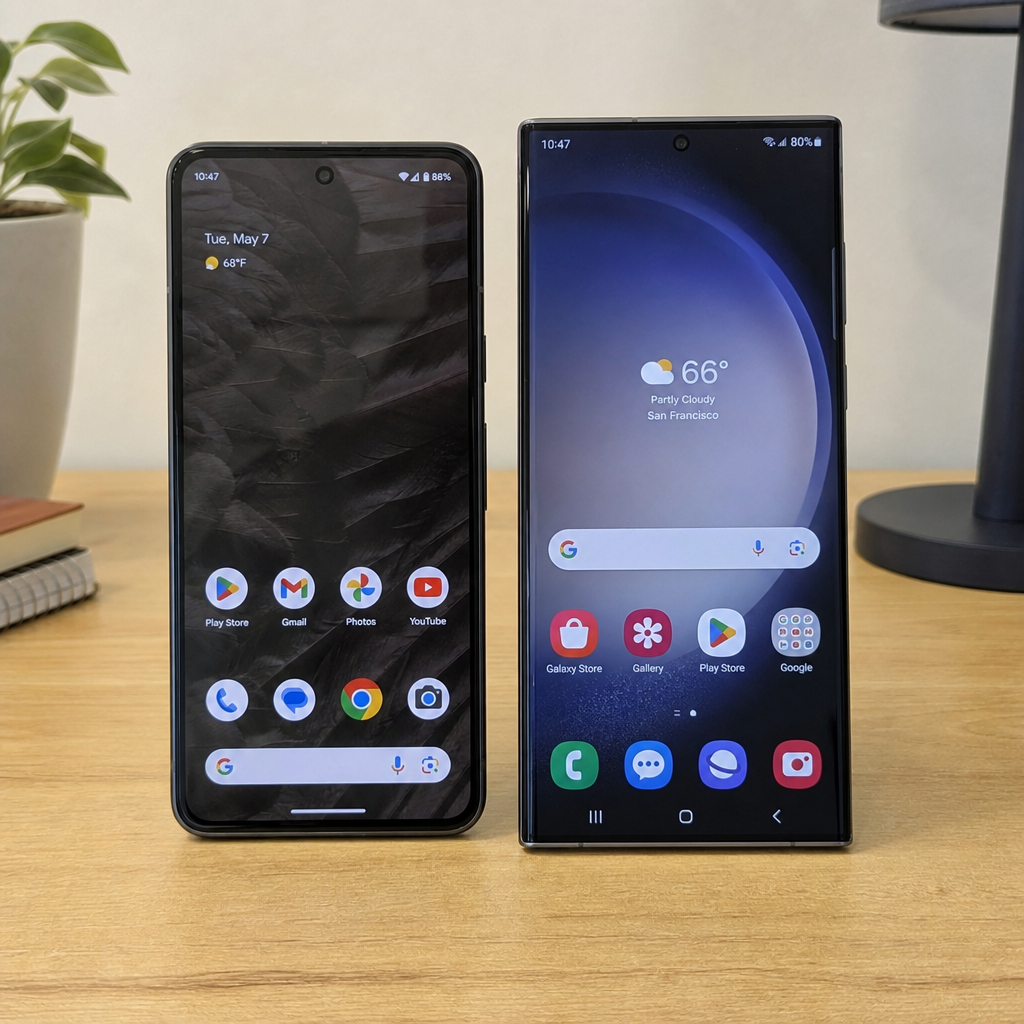
This is where the google versus samsung debate becomes personal. Pixel users often like that the interface feels straightforward, with fewer duplicate apps and less visual complexity. If you already live in Gmail, Maps, Calendar, Photos, Drive, and Google Messages, Pixel reduces friction because those services feel native rather than added on.
Pixel also appeals to people who want their phone to handle small tasks quietly. Google’s Pixel 11 launch focused on more personal Pixel devices and new Pixel hardware, while its support pages continue to emphasize Pixel Drops, OS updates, security improvements, and feature updates over time. (blog.google)
Samsung Galaxy gives you more ways to make Android yours
Samsung’s biggest strength is range. The Galaxy family spans premium S-series phones, foldables, budget-friendly A-series devices, tablets, watches, earbuds, and connected home products. If you want one brand across your phone, tablet, watch, laptop, earbuds, TV, and smart home gear, Samsung has a larger ecosystem to build around.
Samsung’s One UI also gives users more controls. You can adjust quick settings, multitasking behavior, edge panels, lock screen elements, routines, app layouts, display behavior, and device automation in ways Pixel usually keeps simpler. That can feel busy to some people, but it is powerful for users who like tailoring their device.
The Galaxy S26 series also leans into Samsung’s “agentic” Galaxy AI direction, with features such as Now Nudge, Now Brief, upgraded Bixby, multi-object Circle to Search with Google, and AI agents including Gemini and Perplexity. Samsung also highlights Knox, Knox Vault, and a built-in Privacy Display on the Galaxy S26 Ultra. (news.samsung.com)
Camera quality is a battle of processing versus control
The pixel vs galaxy camera decision is not only about megapixels. Pixel is known for computational photography: point, shoot, and let Google’s software produce a polished image. That is especially appealing for everyday photos of people, pets, food, city scenes, and quick moments where you do not want to adjust settings.
Samsung Galaxy tends to give you more hardware variety and creative control, especially on Ultra models. Galaxy phones often appeal to users who want flexible zoom, vivid displays for framing shots, manual-style controls, and a camera system that connects well with editing and sharing tools. Samsung’s Galaxy S26 messaging emphasizes an industry-leading camera system, improved low-light video, AI editing, Super Steady improvements, and natural-language photo editing through Photo Assist. (news.samsung.com)
Google’s current Pixel positioning also leans strongly on AI-assisted camera and photo experiences. Pixel 11 is presented as part of Google’s newest phone family, and Google’s Pixel software support includes ongoing feature drops that may add new and upgraded capabilities during the device’s supported life. (store.google.com)
Is Pixel better than Galaxy for Android updates?
Pixel is better if you want updates directly from Google and the cleanest path to new Android features, while Samsung is now highly competitive on update longevity. Google says Pixel 8 and later phones receive seven years of OS and security updates from their first availability on the Google Store in the U.S.; Samsung says the Galaxy S26 series receives seven generations of OS upgrades and seven years of security updates from global launch. (support.google.com)
That means the old assumption that Pixel automatically crushes Samsung on software support is no longer as simple. Pixel still has the advantage of being Google’s own Android showcase, and new Android ideas may appear there in a very native way. Samsung, however, has turned long-term support into a flagship selling point too.
For buyers, the practical takeaway is simple: do not choose Pixel only because you assume Samsung phones age poorly. Modern Galaxy flagships can be long-term devices. Instead, compare update style: Pixel feels closer to Google’s pure Android roadmap, while Samsung updates arrive through One UI, with Samsung’s own features layered on top.
Performance, battery, and displays favor different users
If you care about raw gaming performance, heavy multitasking, display brightness, advanced cooling, and high-end hardware options, Samsung’s premium Galaxy phones are usually the ones to examine first. Samsung says the Galaxy S26 Ultra uses a customized Snapdragon 8 Elite Gen 5 Mobile Platform for Galaxy and includes redesigned thermal management for demanding use. (news.samsung.com)
Pixel performance is more about Google’s phone intelligence than spec-sheet dominance. Pixel phones are built around Google’s Tensor platform and tight integration with Google AI experiences. That can make Pixel feel fast in the tasks Google optimizes for, such as voice, translation, photo tools, spam protection, search, and contextual assistance.
Battery life depends heavily on model, settings, network conditions, and use. A compact Pixel, a Galaxy Ultra, and a folding phone should not be judged as if they are the same category. If battery is your top priority, compare the exact models you are considering rather than treating google pixel vs galaxy as one universal answer.
The software feel may be the deciding factor
Pixel software feels calmer. It is clean, readable, and less crowded, with Google services at the center. People who dislike duplicate apps, extra menus, or heavy customization layers often feel at home on Pixel quickly.
Samsung software feels more capable and configurable. One UI gives you more settings, more multitasking tools, more display controls, and more ways to connect across Galaxy devices. For some users, that flexibility is the whole point; for others, it can feel like too much.
This is also why the keyword android vs samsung can be misleading. Samsung phones run Android, so the real comparison is not Android against Samsung. It is Google’s Pixel version of Android versus Samsung’s One UI version of Android.
Quick comparison for everyday buyers
Use this checklist if you are deciding between google pixel vs samsung and want a practical answer:
- Choose Google Pixel if you want: a clean Android interface, strong Google app integration, helpful AI features, easy point-and-shoot photography, direct Google updates, and a phone that feels simple from day one.
- Choose Samsung Galaxy if you want: more model choices, premium display options, deeper customization, strong multitasking, Galaxy ecosystem features, powerful Ultra hardware, and more control over how your phone works.
- Choose Pixel for photography if: you usually take quick photos and want reliable processing without much effort.
- Choose Galaxy for photography if: you want zoom flexibility, vivid previews, more controls, and a broader creative toolkit.
- Choose Pixel for software if: you prefer fewer layers between you and Google’s Android experience.
- Choose Galaxy for software if: you enjoy personalization, device automation, and Samsung’s ecosystem extras.
Price and value depend on the model you compare
A fair google pixel vs samsung comparison must match similar tiers. Comparing a standard Pixel to a Galaxy Ultra is not useful, and neither is comparing a discounted Galaxy A-series phone to a Pixel Pro. Decide whether you are shopping budget, midrange, compact flagship, large flagship, or foldable first.
Pixel often makes the strongest case for buyers who want a premium-feeling Google phone without chasing every possible hardware feature. Samsung often makes the strongest case when you want the most choices, from mainstream flagships to Ultra devices and foldables. Promotions, trade-in offers, carrier deals, and storage upgrades can also change the value picture quickly, so compare the final checkout price rather than only the launch price.
Resale value is another factor worth considering when comparing the two brands. A phone that costs less upfront may not necessarily be the better value over time if it depreciates faster. Tools such as Cashmycell depreciation calculator can help buyers estimate a phone’s current resale value and see how that value could change over the coming months, making it easier to look beyond the initial purchase price.
Which one should you buy?
Buy Pixel if you want the phone that feels most “Google”: clean Android, smart calling and photo tools, deep Google services, and a straightforward experience. Buy Samsung if you want the more feature-packed Android phone: richer customization, stronger ecosystem breadth, more premium hardware choices, and productivity extras.
The real winner in pixel vs samsung is the phone that matches your habits. If you want simplicity, Pixel has the edge. If you want flexibility, Galaxy is hard to beat. And if you are still torn, test the camera app, settings menu, keyboard, notifications, and lock screen in person; those everyday moments reveal more than any spec sheet.
Final takeaway
In the google pixel vs samsung rivalry, there is no single permanent champion. Pixel reigns supreme for users who want Google’s cleanest Android experience and AI-first simplicity. Samsung reigns supreme for users who want choice, customization, ecosystem depth, and flagship hardware variety. The best phone is not the one with the loudest marketing claim—it is the one you will enjoy using every hour of the day.
For more insights on smartphone value, resale trends, and what your device could be worth over time, explore Cashmycell.